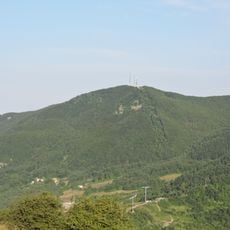
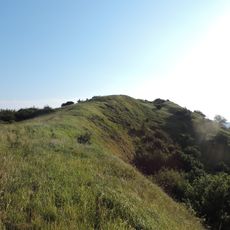
Sasso di San Zanobi, Ophiolite rock formation in Firenzuola, Italy.
The Sasso di San Zanobi is an ophiolite outcrop in the Diaterna torrent valley near the Raticosa pass, at Caburaccia in the municipality of Firenzuola. It is a fragment of basaltic oceanic crust, partly metamorphosed, with serpentine and talc in the rock and greenish and purplish streaks running through it. Two small iron-bearing mounts stand nearby, unlike the surrounding chalky terrain.
A medieval church dedicated to Saint Zenobius once stood near the rock formation and appears in written records from 1299. This early documentation shows how the site was already woven into the area's religious and local story by the Middle Ages.
The name recalls Saint Zenobius, bishop of Florence, who according to tradition met Saint Ambrose near Malomonte in the 4th century and gained new converts between the Diaterna, Caburaccia and Idice. A small church dedicated to him, recorded in the 1299 Libro delle decime, stood by the rock until it was destroyed in wartime. The festa di San Zanobi is held at the foot of the rock on the first Sunday of July.
The rock stands in the Diaterna valley at Caburaccia, in the municipality of Firenzuola, a short distance from the Raticosa pass, which carries the road across the Apennines between Tuscany and Emilia-Romagna. The site lies in the Tuscan-Romagna Apennines, and the nearby Sasso della Mantesca and Sasso delle Macine can be visited on the same outing.
Daniele Luchetti's 1990 film La settimana della Sfinge opens with shots of the Sasso di San Zanobi, but the script later implies the rock lies in the Apennines near Rimini, which is wrong: it stands in the Diaterna valley near the Raticosa pass, in the comune of Firenzuola. In 2011 the rock was filmed at length for the Rai Uno programme Easy Driver.
The community of curious travelers
AroundUs brings together thousands of curated places, local tips, and hidden gems, enriched daily by 94,391 contributors worldwide.