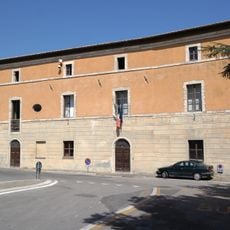
Villa La Rondinella, Private villa in Buonconvento, Italy.
Villa La Rondinella is a residential building in Buonconvento designed with a four-sided layout and brick walls decorated with colorful ceramic pieces and artistic elements. The interior and exterior both display this ornamentation throughout the structure.
Luigi Saverio Ricci commissioned the villa in 1910, the date carved on the rear cornice, to designs by architect Gino Chierici, then an official of the Siena monuments superintendency. Ricci, back from Paris, steered the architect, until then mainly a restorer, toward models taken from architecture magazines. In 1912, amid financial difficulties, he sold the building to his uncle Giuseppe.
The name Rondinella refers to the swallow, and the wrought-iron gates by Luciano Zalaffi carry a stylised central palmette. Local craftsmen Lello Masotti and Vittorio Piochi built the cherry-wood staircase in the atrium after Luigi Saverio Ricci's own design. A painted female figure with wheat ears and vine tendrils, attributed to Primo Lavagnini, decorates the wall left of the entrance.
The villa stands isolated from the town centre, facing the Via Cassia, and its walled estate is entered through two wrought-iron gates; the first sits in a small exedra at the corner with a side road, set slightly back from the roadway. The main gate opens onto a path through an Italian-style garden leading to the gravel forecourt in front of the house. The entrance door is on the connecting wall between the street facade and the rear block, reached by a short marble stair.
The entrance portal carries the word "Salve" carved on its architrave, and the door is sheltered by a wooden canopy covered with bright green glazed terracotta tiles. Above the door, a marble band with grooves runs around the whole building as the parapet of the ground-floor windows.
The community of curious travelers
AroundUs brings together thousands of curated places, local tips, and hidden gems, enriched daily by 93,031 contributors worldwide.