St Mark's Clock, Renaissance astronomical clock at Piazza San Marco, Venice, Italy
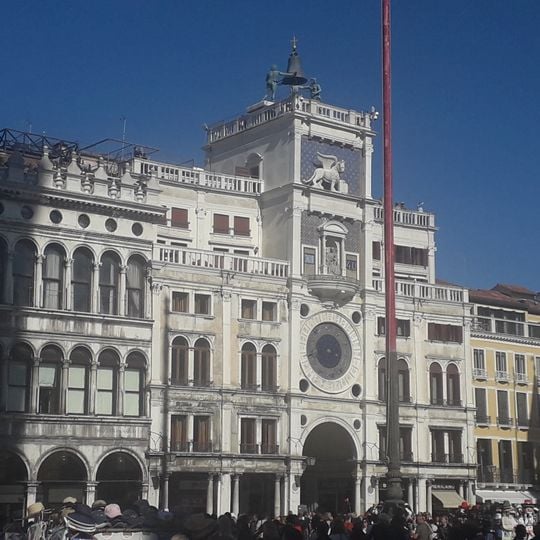
St Mark's Clock occupies the Clock Tower adjoining the Procuratie Vecchie on Piazza San Marco. Its white stone facade rises above an arcade; the central tower carries a circular clock face with a dark centre, golden numerals and zodiac symbols. Above the clock, a balustraded niche holds a golden winged lion on a blue field, and higher still a bell is flanked by two dark statues.
In 1493 the Venetian Republic commissioned Giovan Paolo Ranieri to make the clock movement; construction of the tower began in 1496, and the clock was inaugurated on 1 February 1497. Paolo died in 1498 and his son Gian Carlo finished the work. Bartolomeo Ferracina replaced the mechanism in the 1750s, and a 1996 restoration by Giuseppe Brusa and Alberto Gorla drew criticism.
The clock face displays zodiac signs and moon phases arranged in concentric rings, showing how medieval observers understood the movements of heavenly bodies. This design allowed people standing in the square to read the positions of planets and stars directly.
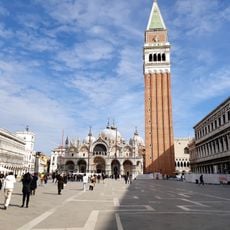
The clock sits on the north side of Piazza San Marco, where the tower's lower two storeys form an archway into the Merceria, the street linking the square to the Rialto. The clock face can be read from the square below, and the tower is one of eleven sites run by the Fondazione Musei Civici di Venezia.
Illuminated numerals were added to the mechanism in 1857, making it one of the earliest examples of lit numerical time displays. This addition reveals how the device adapted to new technologies even centuries after its original creation.
The community of curious travelers
AroundUs brings together thousands of curated places, local tips, and hidden gems, enriched daily by 92,921 contributors worldwide.