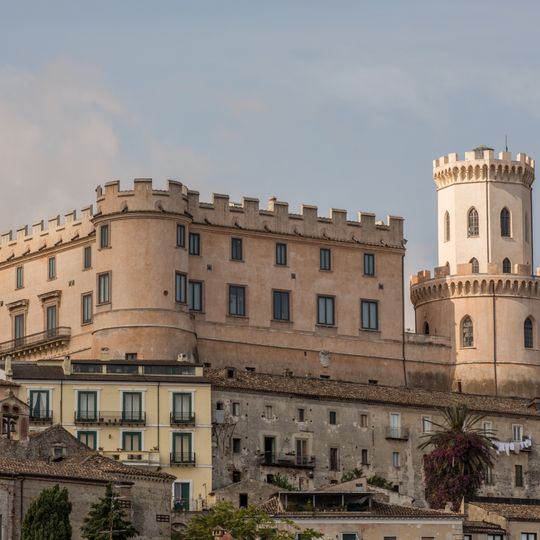
Corigliano Calabro Castle, Medieval fortress in Corigliano-Rossano, Italy
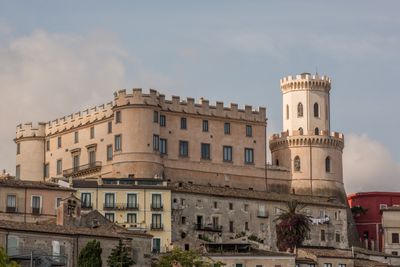
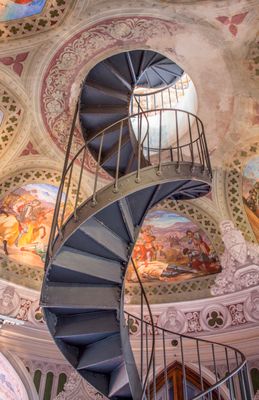
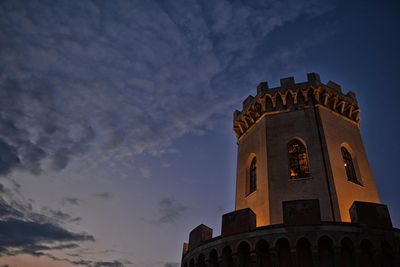
Corigliano Calabro Castle is a fortress with pale tan stone walls rising from a high battered base, its rectangular main block edged with crenellations and a cylindrical tower on the right topped by a ring of crenellations and small arched windows. A smaller round turret projects to the left, and rows of rectangular windows, some shuttered, pierce the walls. Inside, a spiral staircase with dark blue-grey metal treads and a riveted outer band climbs through a painted ceiling.
Robert Guiscard ordered the fortress built in 1073 near Rossano, within the defensive line raised in the Crati valley between 1064 and 1080. In 1192 Tancred of Sicily granted Corigliano as a fief to Ruggero Sanseverino, whose family held it until 1616. Roberto Sanseverino, count from 1339 to 1361, added lordly rooms on the south side, and after 1489 Alfonso of Calabria had the keep, moat and drawbridge strengthened, works finished in 1490.
The castle was long known as Palazzo Sangro, after the dukes of Corigliano who renamed it for their family in the 18th century. Today the upper floor hosts painting and photography exhibitions, conferences and other events, while some chairs of the Università Orientale are housed here.
The castle stands in Corigliano Calabro, in the municipality of Corigliano-Rossano, province of Cosenza. The upper floor hosts temporary painting and photography exhibitions, conferences and other events, so some rooms may be closed to visitors during an event. The spiral staircase shown in the photographs links the levels inside the main block.
The castle was long known as Palazzo Sangro until the 18th century, when it passed to the dukes of Corigliano, who renamed it after their family. The future King Charles III of Naples was born here in 1345. Today some departments of the Oriental University occupy the building.
The community of curious travelers
AroundUs brings together thousands of curated places, local tips, and hidden gems, enriched daily by 94,085 contributors worldwide.