Carpineto viaduct, Cable-stayed viaduct in Vietri di Potenza, Italy
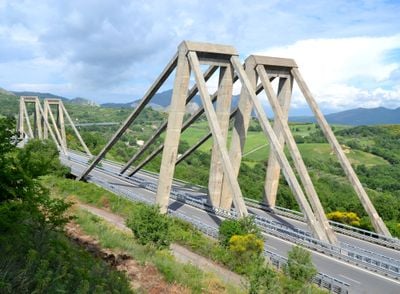
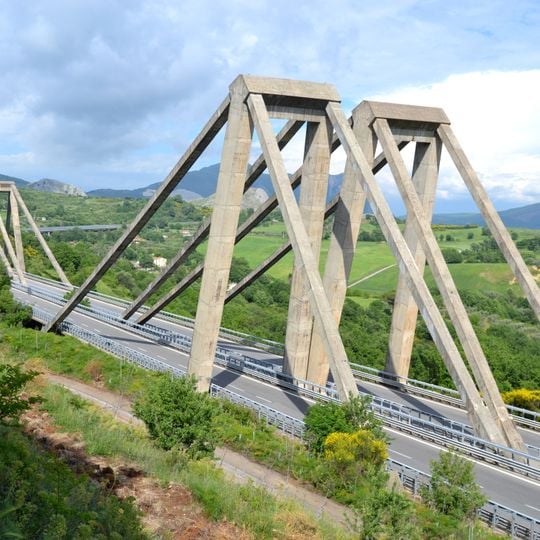
The Carpineto viaduct carries the two carriageways of the RA 5 Sicignano-Potenza link over a hillside hollow near Vietri di Potenza. Designed by Riccardo Morandi, it consists of two parallel cable-stayed bridges, each with two lanes and no hard shoulder. Its two 29 m pylons lean outward and are tied back into 16 m anchor blocks, leaving a single 181 m opening between them.
Riccardo Morandi designed the Carpineto viaduct for the RA 5 Sicignano-Potenza link, and it was completed in 1977. He had already used single-pylon back-anchoring at the Ansa del Tevere viaduct on the Rome-Fiumicino motorway in 1967. At Carpineto two facing pylons each carry a 69.5 m deck girder, and a 42 m suspended span closes the gap between them.
The bridge carries the RA 5 link between the A3 Naples–Salerno motorway and Potenza, with two lanes in each direction and no hard shoulders. Its designer, Riccardo Morandi, had already used single-sided cable anchorage at the Ansa del Tevere viaduct on the Rome–Fiumicino motorway in 1967.
The viaduct carries the RA 5 Sicignano-Potenza link, which connects the A3 from Naples and Salerno with Potenza. Each directional carriageway has two lanes and no hard shoulder, so the structure is seen in passing from the roadway rather than on foot.
The deck is not continuous: each inclined pylon carries a 69.5 m cantilevered beam into the 181 m opening, and a 42 m suspended girder closes the gap between them, working like a Gerber beam. Morandi had used single-pylon back-anchoring earlier at the Ansa del Tevere viaduct (1967).
The community of curious travelers
AroundUs brings together thousands of curated places, local tips, and hidden gems, enriched daily by 93,712 contributors worldwide.