Castello di Sestola, Medieval castle and museum in Sestola, Italy.
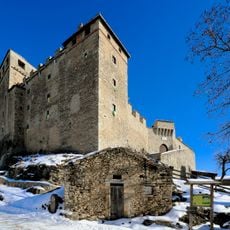
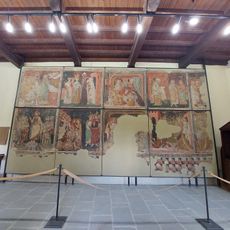
Castello di Sestola is a 16th-century fortress on a rocky spur at about 1080 metres above sea level, on Via Governatori di Frignano. Duke Alfonso II d'Este had the medieval ruins demolished and a new defensive building designed by architect and cartographer Marco Antonio Pasi; construction ran from 1563 to about 1580. Inside are the Museo della civiltà montanara in the former stables and archive, the mechanical musical instruments museum in the former governor's apartment, and the Roncoscaglia frescoes of Saint John the Baptist.
The medieval fortress was destroyed in the wars for the territory, so Duke Alfonso II d'Este had its remains demolished and a new defensive building erected for 16th-century firearms. The project was entrusted to the architect and cartographer Marco Antonio Pasi, and work ran from 1563 to about twenty years later. From 1816 the Rocca became a penitentiary; in 1824 Francesco IV began planting the Fratta pinewood against its walls.
The castle now contains two museums dedicated to mountain life and mechanical musical instruments from different periods. Visitors can see objects that tell stories about how people lived and worked in these highlands.
The fortress stands on a rocky spur at about 1080 metres, in Via Governatori di Frignano, above the oldest houses of Sestola. The tower terrace, fitted with information panels, gives a 360-degree view over the Scoltenna and Leo valleys. Temporary exhibitions are usually held in the Sala del Camino, and the ground floor of the tower shows a small art display that changes during the year.
In the late 1800s, the castle functioned as a weather observation post where scientists recorded meteorological data from its high elevation. This scientific purpose later became the foundation for its transformation into a cultural institution for the wider community.
The community of curious travelers
AroundUs brings together thousands of curated places, local tips, and hidden gems, enriched daily by 93,006 contributors worldwide.