Defensive walls of Volterra, Medieval defensive wall system in Volterra, Italy
The Defensive walls of Volterra are a military engineering work begun in the Etruscan period and modified over the centuries. The surviving Etruscan great circuit ran over seven kilometres and enclosed about 116 hectares, of which little more than a fifth remains; the medieval wall now visible is 2.6 km long and encloses 26 hectares. The walls are built of panchino, a very fine-grained, sand-yellow stone from western Tuscany, also used for cinerary urns, palace masonry and street paving.
The first circuit was built around the mid-6th century BC; the great Etruscan ring, over 7 km long and enclosing about 116 hectares, followed in the 4th century BC, dated by some scholars to the 3rd. In the early 13th century the commune began a smaller medieval wall, finished around 1266, which incorporated the Etruscan Porta Diana and Porta Menseri. In 2014, 30 m of medieval wall collapsed in bad weather.
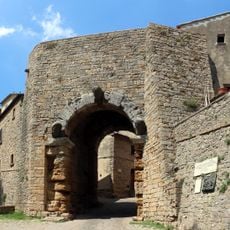
The three main Etruscan gates each led to a different road: Porta all'Arco south toward the Val di Cecina and the metal hills, Porta Diana (Portone) north toward the Valdera, and Porta Solis southeast toward the Valdelsa, its remains found in 1994 inside the Medici fortress. Smaller posterns, such as Sant'Andrea in postierla, kept their names in local toponymy.
Walking along the walls offers views of the structure itself and the surrounding Tuscan fields and hills. It helps to wear comfortable shoes since the path is uneven and becomes steep in places.
The walls' stone is panchino, a very fine-grained sandstone of sand-yellow colour, also used for cinerary urns, palace masonry and street paving. At least three ancient quarry zones have been identified along the circuit, and in places the builders cut the rocky slope itself to serve as part of the curtain.
The community of curious travelers
AroundUs brings together thousands of curated places, local tips, and hidden gems, enriched daily by 93,441 contributors worldwide.