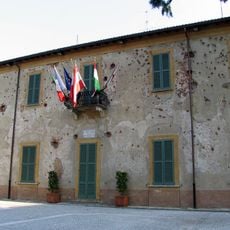
Castelletto, Castle in Corbetta, Italy
Castelletto is the surviving walled fragment of a castle begun in the 9th century in Corbetta, Lombardy, on Piazza Corbas. Of the original quadrangular plan with a defensive tower at each corner, only one corner tower still stands; the rest results from restorations around 1880 by Carlo Frisiani, in 1941-1942 by architect Piero Portaluppi, and from additions in 1959-1963.
The Castelletto is the last surviving wall fragment of a 9th-century construction. By the 11th century it belonged to the archbishops of Milan, who used it for defence; on 29 May 1037 Emperor Conrad II attempted to besiege it. Devastated by Frederick Barbarossa in 1154 and Frederick II in 1239, it was enlarged from 1270 under Napo Torriani and later the Visconti. Obsolete by the 17th century, it was largely dismantled and its material reused for nearby villas.
The castle is also called Castrum Sancti Ambrosii, Castello di Sant'Ambrogio or Castello del Crociato. Its name recalls the apparition of Saint Ambrose on horseback, whip in hand, that Landolfo il Vecchio reported during Conrad II's siege of 1037, when the emperor withdrew.
The complex stands on Piazza Corbas in Corbetta, reachable on foot from the town centre. The garden, laid out between 1950 and 1970, holds the remains of the perimeter walls of the Roman castrum of Curia Picta and the tomb of a centurion. Look for the angel once placed on the bell tower.
The garden preserves traces of the perimeter walls of the Roman castrum of Curia Picta, along with finds such as the tomb of a centurion and an angel statue once placed on the bell tower, which local legend surrounds. The colonnade and a door apse came from a 16th-century Stimmatini monastery in Sezano, near Verona, donated by the Cartiere di Fabriano.
The community of curious travelers
AroundUs brings together thousands of curated places, local tips, and hidden gems, enriched daily by 94,301 contributors worldwide.