Castello della Rotta, Medieval castle in Moncalieri, Italy.
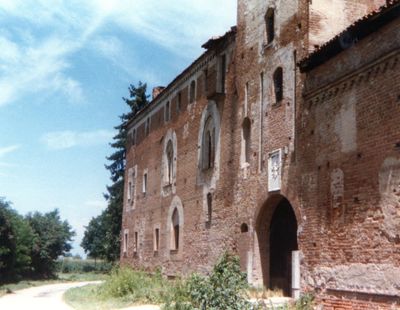
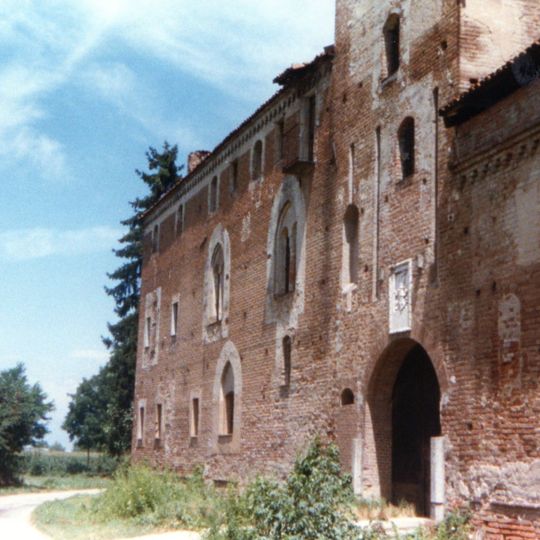
Castello della Rotta is a medieval brick building in the hamlet of La Rotta, Moncalieri, south of Turin. Its square plan is dominated by an asymmetric facade with a quadrangular tower topped by a small bell gable, and traces of a moat that once surrounded the whole perimeter. Two surviving pointed-arch windows and traces of crenellation on the left side date to 15th-century works.
The castle dates from the 12th century; in 1196 the bishop of Turin, Arduino di Valperga, granted the building and its lands to the Knights Templar, who made it a small convent and a garrison guarding the bridge over the Banna. After the order was dissolved it passed to the Knights of Hospitaller, who collected a toll for the bridge crossing. In the 15th century it was remodelled and fortified against brigands, and from 1452 it belonged to Giorgio Valperga di Masino, Grand Prior of the Hospitallers.
The name Rotta has several proposed origins: rupta, a military defeat, rotha, an irrigation ditch, or a break in the banks of the Banna and Stellone streams. Thirteenth-century cadastral records call the building Grancia Rupta, a fortified farm. Two stone plaques remain: one placed by Giorgio Valperga di Masino after 1452, and one above the entrance portal bearing the Valperga di Masino coat of arms.
The castle is privately owned and not open to visitors. It stands in a wooded, shaded spot reached by a secondary road branching off the SP393 toward Villastellone, close to the A6 Turin-Savona motorway. The old Templar bridge over the Banna stream survives only as ruins, so the building is seen from the lane outside.
Archaeological excavations at the site uncovered human remains including a knight from the 15th or 16th century buried alongside his horse. This rare discovery reveals how closely warriors and their animals were bound in medieval times.
The community of curious travelers
AroundUs brings together thousands of curated places, local tips, and hidden gems, enriched daily by 93,939 contributors worldwide.