Chiesa di San Carpoforo, Former church and Italian national heritage site in central Milan, Italy
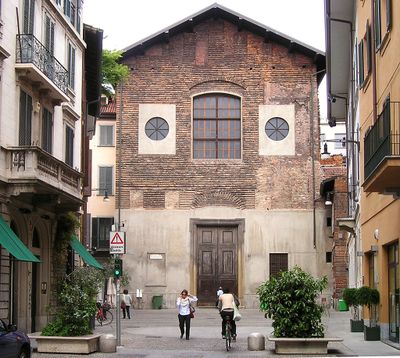
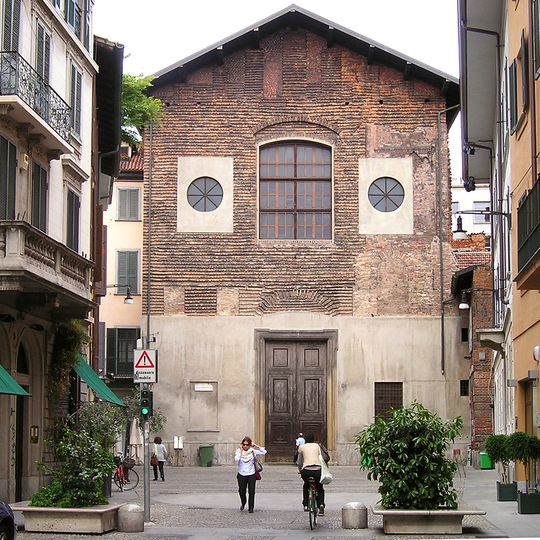
San Carpoforo is a former church at Via Formentini 10 in central Milan. Its gabled facade combines exposed brick and rough plaster: the upper brick section has a large arched window with a wooden grid, flanked by two plaster panels with round windows, while below, a wooden double door in a stone frame sits beneath an inscribed stone plaque, with a small rectangular window to its right and another stone plaque to its left.
The site originated as a Roman temple dedicated to pagan worship, and was first documented as a church around 813. This transformation from a pagan sanctuary to a Christian place of worship reflects the religious changes that swept through medieval Milan.
The name San Carpoforo echoes the Roman altar to a fruit-bearing deity ("carpofora"), later identified as Vesta, found on the site. Tradition credits Santa Marcellina, sister of Sant'Ambrogio, with the consecration to the saint; she lived nearby until her death in 404. Until the mid-19th century, people still believed the well water of a house facing the square, called "acqua di santa Marcellina", had miraculous properties.
The former church stands at Via Formentini 10, in Milan's historic centre, between neighbouring buildings. Since 1993 it has been granted free of charge to the Brera Academy of Fine Arts, which uses it for courses in decoration, restoration and contemporary sacred art, so access follows the school's teaching activity rather than fixed visiting hours.
In 1976 the artist Franco Mazzucchelli installed one of his PVC inflatable works inside the former church, part of his series of "riappropriazioni" of urban spaces. The building had passed under the control of the Soprintendenza before being granted in 1993 for free use to the Brera Academy.
The community of curious travelers
AroundUs brings together thousands of curated places, local tips, and hidden gems, enriched daily by 93,817 contributors worldwide.