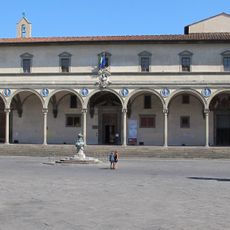
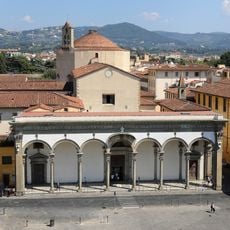
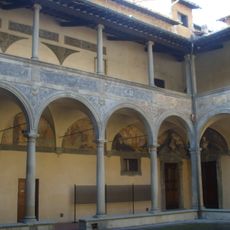
Palazzo della Crocetta, Renaissance palace in San Giovanni district, Florence, Italy.
Palazzo della Crocetta occupies a block between Via della Colonna, Piazza Santissima Annunziata, Via Gino Capponi, Via Laura and Via della Pergola. Giulio Parigi's 1619 design gave it a U-shaped plan that absorbed earlier houses on Via della Pergola. On Via della Colonna the front runs 24 bays over three tall storeys, turning the corner into Via Laura and continuing as the garden wall.
Architect Giulio Parigi built the palace between 1619 and 1651 for Princess Maria Maddalena de' Medici on land belonging to a nearby charity hospital. The National Archaeological Museum moved in during 1880 and has occupied the building ever since.
The palazzo's name comes from the nearby Monastero della Crocetta, and since 1880 it has housed the Museo Archeologico Nazionale, uniting the previously separate Etruscan and Egyptian museums. In 1897 director Luigi Adriano Milani opened a Topographical section arranging finds by excavation site. The garden, public since 1902, holds Etruscan tombs rebuilt with original materials.
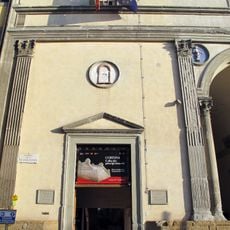
The museum entrance is on the Piazza della Santissima Annunziata side, in the building bought in 1942; the original access was on Via della Colonna. Collections occupy the ground floor, first floor and, since 1925, the second floor. The garden, open to the public since 1902, holds reconstructed Etruscan tombs built with original materials.
The palazzo originally featured an elevated corridor connecting it to nearby religious buildings, enabling the princess to move between them without walking through public streets. This hidden passageway was a sign of her status and freedom within the city.
The community of curious travelers
AroundUs brings together thousands of curated places, local tips, and hidden gems, enriched daily by 93,764 contributors worldwide.