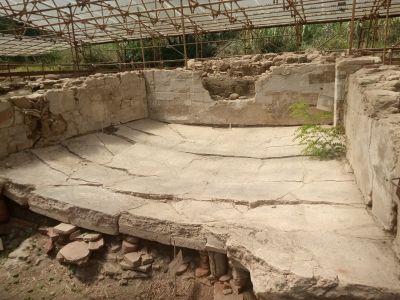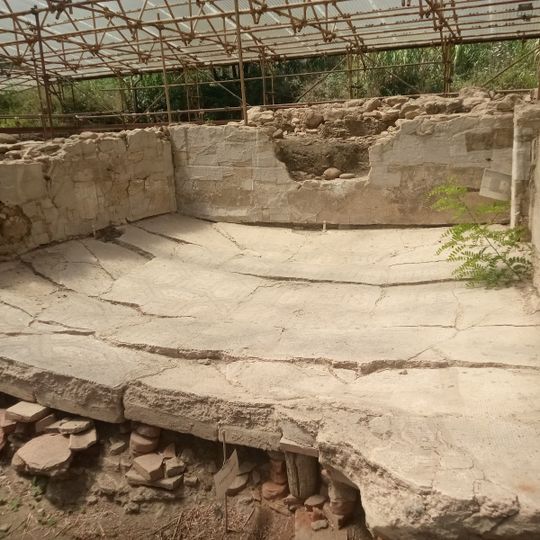
Baths of Bagnoli, Roman thermal complex in Capo d'Orlando, Italy.
The Baths of Bagnoli are part of a Roman seaside villa in contrada Bagnoli-San Gregorio, Capo d'Orlando. Six rooms have been excavated, including a tepidarium (room 4) and a caldarium (rooms 5–6) with hypocaust heating. The frigidarium had three rooms. Polychrome geometric floor mosaics, close to North African styles, cover the floors.
The baths belonged to a seaside Roman villa built in the early 3rd century AD. Two earthquakes between the 4th and 5th centuries damaged the structure. The first ruins came to light in 1987 during excavation work at Bagnoli, and archaeologists have not ruled out that a whole settlement lies buried nearby.
The polychrome floor mosaics are in tassellatum, made of stone and marble tesserae, with geometric designs stylistically close to North African mosaics. Damaged areas suggest figures were also included. The villa was a luxurious seaside residence, and its baths were decorated with these floors.
Visitors can explore six excavated rooms of the thermal complex, though some sections remain covered by modern structures. Access is limited in certain areas since parts of the site have not yet been fully excavated or opened to the public.
Most of the villa still lies under modern buildings and a road, so only part of the baths has been excavated. The polychrome floor mosaics are geometric and stylistically close to North African work, and the damaged areas suggest that figured scenes were once part of the decoration.
The community of curious travelers
AroundUs brings together thousands of curated places, local tips, and hidden gems, enriched daily by 94,418 contributors worldwide.