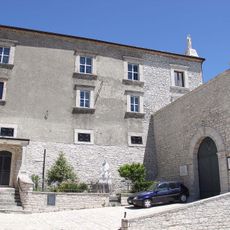
Villa De Capoa, 18th-century palace and garden in Campobasso, Italy.
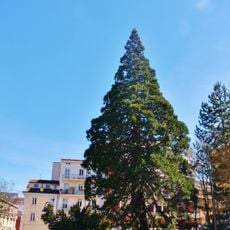
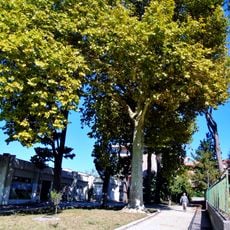
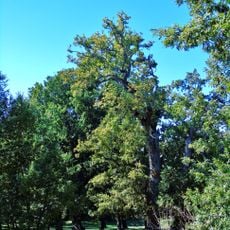
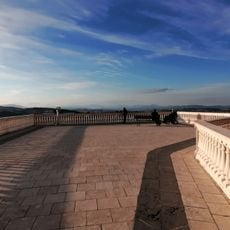
Villa De Capoa is a garden of about 16,000 square metres in central Campobasso, entered through a wrought iron gate on Piazza Falcone e Borsellino. Along the main avenue stands a statue of Bacchus with grape clusters; inside are a tufa grotto, a basin with a water jet, a stone balcony overlooking a small square, and two 15th-century tombs.
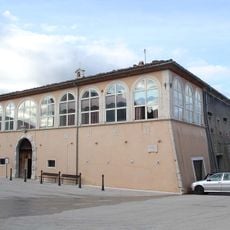
The garden originated in the 18th century as the herb garden of the former monastery of Santa Maria delle Grazie, built by Andrea De Capoa and used by the monks to grow herbs and prepare medicines. It was later bought by private owners and rearranged as a promenade. In 1875 Countess Marianna De Capoa donated villa and park to the municipality of Campobasso.
Two 15th-century-style tombs stand in the garden: one holds Alcon, the dog, the other the soldier Ricciardi Rota, who died in 1492. The main avenue is watched over by a statue of Bacchus with clusters of grapes, a motif tied to the garden's origins as a monastic herb garden.
The main entrance is a wrought iron gate on Piazza Falcone e Borsellino, the square formerly called Piazza Savoia, in the city centre. Inside, a main avenue leads past the statue of Bacchus with grape clusters; the grounds cover about 16,000 square metres.
Two tombs stand in the garden: one holds Alcon, the De Capoa family dog, the other the soldier Ricciardi Rota, who died in 1492. The dog's burial beside a Renaissance-style tomb is easy to miss along the paths.
The community of curious travelers
AroundUs brings together thousands of curated places, local tips, and hidden gems, enriched daily by 94,355 contributors worldwide.