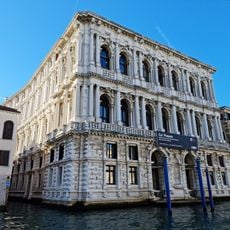
Palazzo Gussoni Grimani Della Vida, Renaissance palace in Cannaregio, Venice, Italy.
Palazzo Gussoni Grimani Della Vida is a Renaissance palace along the Grand Canal in Venice with a symmetrically designed facade marked by horizontal and vertical divisions. The building displays typical Venetian architectural elements, including the distinctive multi-light windows that characterize this period.
Built between 1548 and 1556 for the Gussoni family, the palace is generally attributed to Michele Sanmicheli. It housed the English embassy from 1614 to 1618 and the Accademia Delfica, also called Gussoniana, from 1647 to 1690. The male line died out in 1735 with Senator Giulio Gussoni; the Grimani bought the palace in the 18th century, and Cesare Della Vida acquired it in 1816. It now houses the Regional Administrative Court of Veneto.
Between 1647 and 1690 the palace housed the Accademia Delfica, also called Gussoniana, which the sources describe as devoted to the study of eloquence. The academy's name and the palace's second name, Gussonia, both come from the Gussoni family, who built the palace and kept it until 1735.
The palace faces the left bank of the Grand Canal in Cannaregio, opposite Ca' Pesaro and next to Casa Velluti. It now houses the Regional Administrative Court of Veneto, so the interior is not open as a museum; the facade and courtyard are best seen from the canal or from the opposite bank near San Stae and Ca' Pesaro.
The facade frescoes by Tintoretto, showing Dawn and Dusk after Michelangelo's Medici Chapel sculptures, are lost; they survive only in engravings Antonio Maria Zanetti published in 1760. The courtyard still has Zelotti's frescoes of Hector in various poses.
The community of curious travelers
AroundUs brings together thousands of curated places, local tips, and hidden gems, enriched daily by 94,673 contributors worldwide.