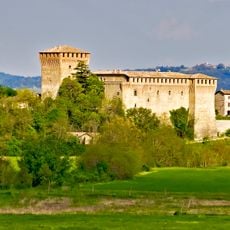
Castello di Castelcorniglio, 16th century castle in Solignano, Italy.
Castello di Castelcorniglio is a stone fortress situated on the left side of Val Pessola valley with four corner towers and three inner courtyards enclosed by defensive walls. The layout shows typical early modern defensive design with distinct areas for different functions and activities.
The castle is first documented in 1226, when Corniliolum appears in the Statuti di Parma among the fortresses guarding the lower Ceno valley for Parma. It passed to Manfredo Pallavicino, invested in 1249 by Frederick II with Specchio and Solignano, and in 1430 Gian Galeazzo Visconti's line granted it to the condottiere Niccolò Piccinino. The Pallavicino held it until their Specchio branch died out in 1690, followed by the Valeri and Rugarli counts, whose feudal rights ended in 1805 under Napoleon.
The first-floor library assembled by the Zanetti family holds 16th- and 19th-century works. The same rooms keep a collection of Napoleonic toy soldiers and documents recording the castle's owners' support for the legitimists during the French Revolution.
The castle stands on the steep left slope of the Pessola valley, near the hamlet of Specchio in Solignano, and is reached by a winding hill road. The complex is now run as a farm and agriturismo, so the courtyards and gardens are not a public monument with fixed visiting areas; arrange a visit in advance rather than relying on drop-in access.
Inside the castle's inner courtyard stands an ancient well that local tradition claims was used for executing prisoners. This dark chapter of the past remains woven into the stories people tell about the building today.
The community of curious travelers
AroundUs brings together thousands of curated places, local tips, and hidden gems, enriched daily by 94,019 contributors worldwide.