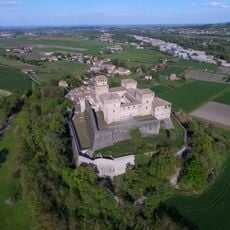
Castle of Castrignano, Medieval castle ruins in Langhirano, Italy
The Castle of Castrignano is a ruined medieval hilltop fortification beside the Church of the Assumption of Mary in Castrignano, a hamlet of Langhirano. Only foundations and scattered stone remains survive; part of the ruins was reused as the gateway to the churchyard. The original castle stood next to a Lombard settlement and was traditionally founded by a certain Regnano.
The castle, called Castrum Regnani, is first documented on 31 July 982 in a lease granted by Bishop Sigefredo II of Parma. In 1116 Emperor Henry V confirmed possession to the abbot of Sant'Apollonio di Canossa; in 1137 Emperor Lothair II assigned the fief to the monastery of San Prospero in Reggio Emilia. In 1186 Frederick Barbarossa gave castle and lands to Bishop Bernardo II of Parma after his son Henry VI married Constance of Hauteville.
The castle's name comes from the legendary founder Regnano, and the site is documented as Castrum Regnani from 982. Part of the ruins was later rebuilt as the entrance portal to the churchyard of the Church of the Assumption of Mary, so the fortress and the parish church now share the same small hill.
The ruins can be reached through the church grounds and are partly integrated into the cemetery area, making them accessible during a visit to the site. Expect uneven terrain since this is an old hillside fortification with areas that have not been fully stabilized.
The fortress gained its most notable recognition in 1186 when Emperor Frederick Barbarossa granted it to the Bishop of Parma as thanks for attending his son's wedding. This connection between a military stronghold and a princely bishop's gift reveals how power networks operated in the medieval world.
The community of curious travelers
AroundUs brings together thousands of curated places, local tips, and hidden gems, enriched daily by 94,475 contributors worldwide.