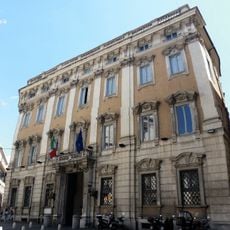
Palazzo Caetani, Renaissance palace in Sant'Angelo district, Rome, Italy
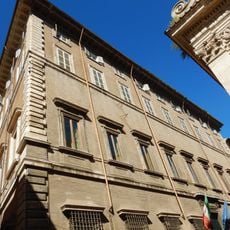
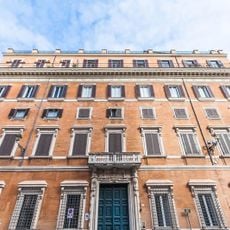
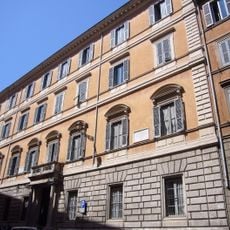
Palazzo Caetani stands at via delle Botteghe Oscure 32 in the Sant'Angelo district, the first building of the Insula Mattei given a fully palatial layout. Alessandro Mattei had it built between 1545 and 1564, most likely to a design by Nanni di Baccio Bigio, continued by his son Annibale. Ciriaco Mattei added the second row of square windows on the first floor; the Ginnetti later widened the entrance portal for carriages.
Construction of the palace began in 1545 under patron Alessandro Mattei and architect Nanni di Baccio Bigio, finishing in 1564. The Caetani family purchased the property in 1776 and established it as a significant cultural residence.
The palace chapel and its antechamber were frescoed by Cristoforo Roncalli, called Pomarancio, with his pupils Giuseppe Agellio and Alessandro Presciati, while Ambrogio Bonvicino made the stuccoes. Pietro Paolo Olivieri designed the wooden ceiling, carved by Giovanni Volpetta da Castiglione and Carlo Nuti. The name Caetani comes from the family that bought the building in 1776.
The Brazilian Embassy to the Vatican occupies part of the building while the Caetani Foundation maintains a research library within it. Check ahead to learn which areas are open to visitors since some sections remain private or restricted.
Caravaggio stayed at the palace in 1601–1602 as a guest of Ciriaco and Asdrubale Mattei, who commissioned works from him, among them the Cena in Emmaus, the San Giovanni Battista and the Cattura di Cristo. None of these paintings remains in the palace collection today.
The community of curious travelers
AroundUs brings together thousands of curated places, local tips, and hidden gems, enriched daily by 92,948 contributors worldwide.