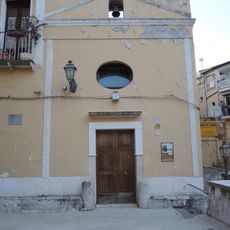
Former Cathedral of St. Erasmus, Renaissance parish church in Formia, Italy.
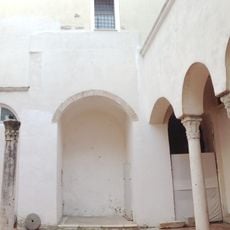
The former Cathedral of St. Erasmus has a gabled facade preceded by a three-bay portico whose three round arches rest on piers with ancient marble columns embedded in them; above is a large rectangular window and a triangular pediment. Inside, three naves of five bays each are covered by cross vaults, divided by two rows of square Gothic stone piers with medieval half-columns along the central nave, which ends in a rectangular apse.
This structure was built as a cathedral and is connected to the veneration of Saint Erasmus, a bishop whose life concluded in this city during ancient times. Its conversion to a parish church reflects how the city's religious organization evolved across the centuries.
The parish, erected in 1599, keeps a polychrome processional statue of Saint Erasmus from the 18th century in a niche at the end of the right nave. The church was served by Olivetan monks from 1491 until religious orders were suppressed in 1806.
The church is typically accessible during daytime hours, and visitors should wear respectful clothing appropriate for religious spaces. A visit can easily fit into a broader exploration of Formia's town center.
Under the church floor, excavated between 1970 and 1976, lie a Roman necropolis of the 1st–4th centuries, the 4th-century martyr's tomb, the 5th-century primitive cathedral and the Carolingian semi-annular crypt, with 11th-century Benedictine workshops and 16th-century Olivetan rooms in adjoining spaces.
The community of curious travelers
AroundUs brings together thousands of curated places, local tips, and hidden gems, enriched daily by 93,758 contributors worldwide.