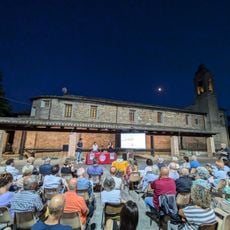
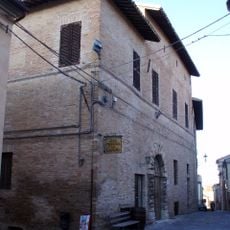
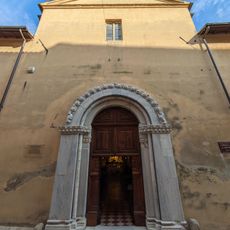
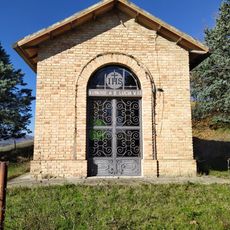
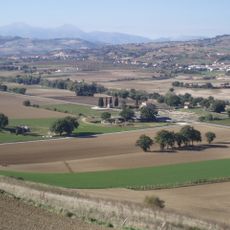
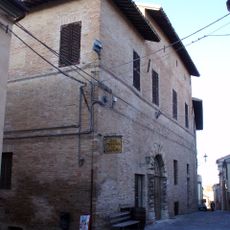
Corinaldo's walls, Medieval fortification walls in Corinaldo, Italy.
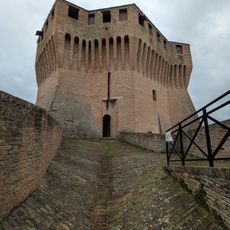
Corinaldo's walls form a well-preserved medieval defensive ring with multiple gates and towers integrated into the structure. The fortification shows the practical defensive features of its era, including narrow openings for archers and projecting elements for overlooking the approaches.
After being destroyed by papal forces in 1360, the walls were reconstructed starting in 1367 under Pope Urban V. Further reinforcements came during the Renaissance period between 1484 and 1490, when the fortification was upgraded with contemporary military designs.
The swallowtail merlons visible along the walls date from the reconstruction after 1367, while the southern addition of 1484–1490 by Francesco Di Giorgio Martini introduced beccatelli, projecting brackets supporting the parapet. The gates still carry the names of their former functions: Porta di San Giovanni housed the Bargello and guard corps, and Porta di Santa Maria del Mercato incorporates a 14th-century gate, remains of a drawbridge and a polygonal tower.
Three gates give access to the walled town: Porta di San Giovanni, Porta di Santa Maria del Mercato and Porta Nova. The last was partly buried in 1850 when the ring road was built. The gates and towers can be viewed from outside along that road, and the 912-metre circuit is best followed on foot.
The swallowtail merlons visible along the ramparts date from the reconstruction licensed by Pope Urban V in 1367, seven years after Galeotto I Malatesta's papal army razed Corinaldo on 18 August 1360. The southern stretch, added between 1484 and 1490 by Sienese military architect Francesco Di Giorgio Martini, is flatter and carried on projecting brackets. The Torre dello Sperone reaches the circuit's maximum height of 18 metres.
The community of curious travelers
AroundUs brings together thousands of curated places, local tips, and hidden gems, enriched daily by 93,592 contributors worldwide.