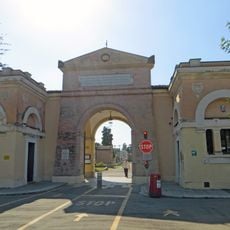
Barriera Bixio, building in Parma, Italy
Barriera Bixio is a neoclassical customs barrier of 1866, not a Renaissance gate: it consists of three curved iron gates between four brick pillars topped by four seated stone statues of the regions of the Kingdom of Italy, flanked by twin T-plan buildings with Doric porticoes and pediments. The Renaissance Porta San Francesco, built in 1562–1563 for Duke Ottavio Farnese, stands isolated to its west, its brick front with a round-arched portal, putti and allegories of Law and Justice.
The medieval Porta San Francesco, opened in 1261 on the road to the Apennines and the Via Francigena, was closed in the mid-16th century. Duke Ottavio Farnese had a new Renaissance gate built slightly to the west in 1562–1563, aligned with a rebuilt pentagonal bastion. In 1860 Luigi Carlo Farini turned Parma's gates into customs barriers; the Bixio barrier, designed by Angelo Angelucci, was inaugurated on 4 November 1866 and named after Nino Bixio in 1882.
The barrier and street were named in 1882 after Nino Bixio, the patriot of the Expedition of the Thousand; until then they honoured King Vittorio Emanuele II. The four seated stone figures on the pillars represent the four regions that made up the Kingdom of Italy in 1860. The Renaissance gate now houses the Famija Pramzana cultural club.
The gate stands at the end of Strada Nino Bixio in the Oltretorrente district, west of the Bixio barrier. The inner square, named after Tommaso Barbieri since 1951, is a roundabout with a large sundial at its centre. The Renaissance gate is isolated after the 1908 demolition of the walls, so it can be approached on foot from the surrounding streets.
The Bixio barrier was inaugurated on 4 November 1866 as the Vittorio Emanuele II barrier, celebrating Parma's annexation to the Kingdom of Italy; it was renamed after Nino Bixio only in 1882. The monument to King Vittorio Emanuele II planned for the centre of the square was never built. The four seated stone figures on the pillars represent the four regions that made up the Kingdom of Italy in 1860.
The community of curious travelers
AroundUs brings together thousands of curated places, local tips, and hidden gems, enriched daily by 94,978 contributors worldwide.