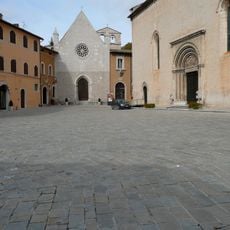
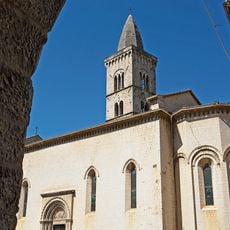
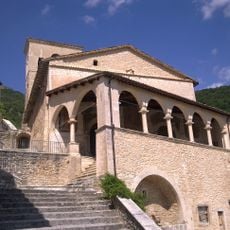
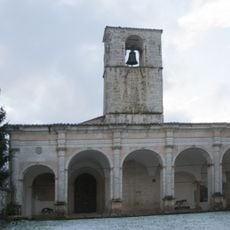
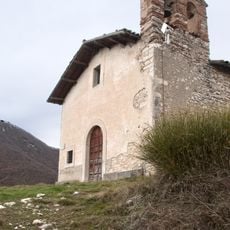
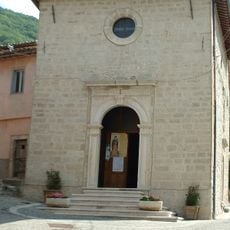
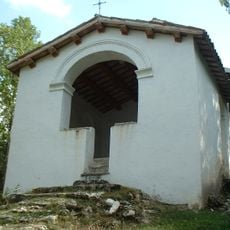
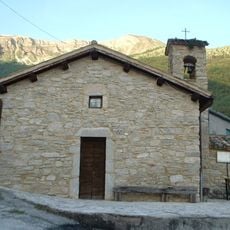
Church of San Salvatore, Campi, Romanesque church in Campi, Italy.
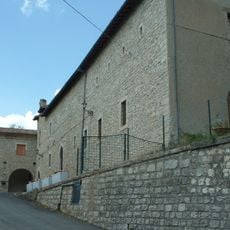
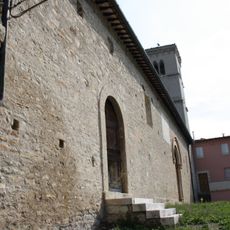
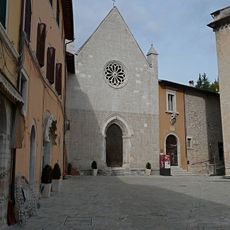
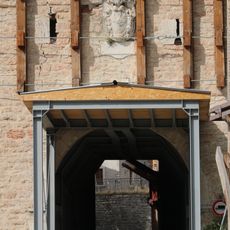
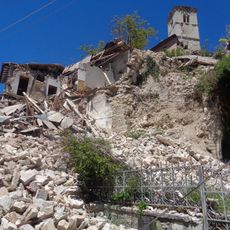
The Church of San Salvatore in Campi was a Romanesque stone building with two naves sharing a single symmetrical façade. It had two carved portals, the right one bearing the year 1491, two rose windows, and a narrow porch on a central column. A bell tower begun in the 15th century and completed around 1538 stood at the rear. The church collapsed in the October 2016 earthquakes; only part of the right perimeter wall and a pile of rubble remain.
First documented in 1115 as a dependency of the Benedictine Abbey of Sant'Eutizio, the church replaced a Roman temple later dedicated to Saint Mary. After the 1328 earthquake, it was rebuilt in the 14th century with a longer nave and raised presbytery. In the late 15th century a second nave was added, and in 1493 it passed to the parish of Sant'Andrea del Castello and was rededicated to San Salvatore.
The left aisle held frescoes by Giovanni and Antonio Sparapane, Nicola d'Ulisse and Domenico di Jacopo, plus a loggia with an iconostasis. The right aisle was plainer, but its 1528 schiazze floor was engraved with an unrealized project for a bell tower.
The church collapsed completely in the earthquakes of 26 and 30 October 2016. As of January 2017, only a portion of the right perimeter wall, secured, and a pile of rubble covered by a black tarp to protect ancient frescoes remain. The adjacent cemetery was also severely damaged. The site is not a visitable interior.
The left portal carried a carved lamb, the agnus Dei of the Benedictine order, while the right portal was the more ornate and bore the year 1491, likely marking completion of the late-15th-century enlargement. The two entrances thus record both the monks who administered the church and the community that doubled its size.
The community of curious travelers
AroundUs brings together thousands of curated places, local tips, and hidden gems, enriched daily by 94,454 contributors worldwide.