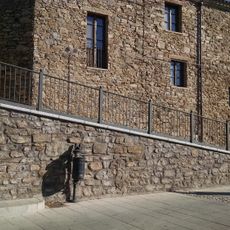
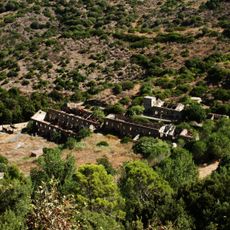
Pozzo sacro Is Pirois, Nuragic holy well in Villaputzu, Italy.
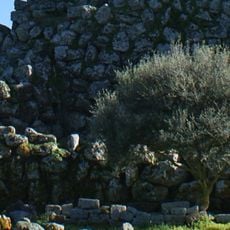
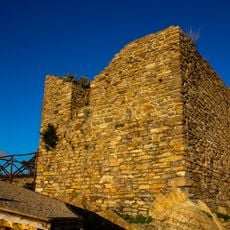
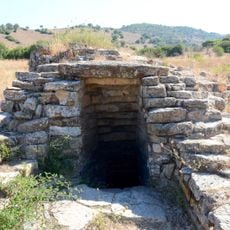
Pozzo sacro Is Pirois is a Nuragic sacred well built of local schist on a slight slope, with a rectangular vestibule about 2 m wide and 3.50 m long. Eight covered steps lead down a stair less than 1 m wide to a circular well chamber roofed by an intact conical tholos only about 75 cm across, open at its oculus. Above it sits a partly ruined second tholos chamber roughly 2.80 m in diameter; the whole structure rises about 4 m.
The well was found by chance during the construction of a stable just uphill and excavated from 1982 by Maria Luisa Ferrarese Ceruti; her work stayed unpublished after her death. Donatella Salvi directed stabilization works in 2002. The monument is not directly dated, but its similarity to other wells places its construction between the Late Bronze Age and the Early Iron Age, roughly 1200–720 BC.
The upper chamber above the tholos has no entrance and connects to the well only through the oculus. Donatella Salvi suggested that during particular rites "someone or something" had to be placed in this room, which was likely covered by a conical or domed roof. The rectangular vestibule was probably roofed with stone slabs or wood and plant material.
Access is via state road 125 toward Tertenia, from which a dirt track leads to the site. Wear sturdy shoes and be prepared to cross a small river and walk on unpaved ground.
Above the underground tholos sits a second, partly ruined tholos chamber with an inner diameter of about 2.80 m, often mistaken for a single-tower nuraghe. It has no doorway and connects to the well only through the oculus. Donatella Salvi suggested that during particular rites "someone or something" had to be placed in this inaccessible room.
The community of curious travelers
AroundUs brings together thousands of curated places, local tips, and hidden gems, enriched daily by 93,403 contributors worldwide.