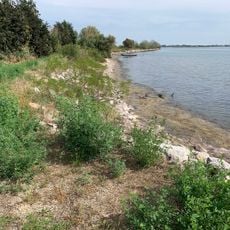
Fort Treporti, Fort in Punta Sabbioni, Cavallino-Treporti, Italy
Forte Treporti, also called Forte Vecchio, is a lunette-plan fortress built of red brick and white Istrian stone on the Cavallino-Treporti coast at Punta Sabbioni. It has an arched front, a large inner courtyard protected by earthworks that are now levelled, and a surrounding artificial moat linked to the lagoon. The site covers over 26,000 m², of which about 3,800 m² are built, 10,400 m² open ground and 12,400 m² moat.
Construction began in 1845 under the second Austrian rule and ended in 1851 with a two-level layout, gun battery and moat. Its purpose was to guard one of the water approaches to Venice. A powder magazine was added in 1900, and in 1915 the Italian garrison built brick rangefinder towers with iron fittings. After 1945 the fort sheltered displaced people and refugees, and some families descended from the first occupants still live there.
The fort functions as a gathering space where local groups use its rooms for meetings and events, creating a bridge between military history and community life. This dual role helps residents maintain a connection with the area's defensive past.
The site covers over 26,000 m², of which about 3,800 m² are built and 10,400 m² open, with the rest taken by the surrounding moat. The earthen ramparts that once protected the inner courtyard have been levelled, so the ground is uneven in places. The fort lies at Punta Sabbioni, at the end of the Cavallino-Treporti coastal strip, and is part of the "Via dei Forti" museum route.
The fort's total area exceeds 26,000 m², but only about 3,800 m² are built structures; roughly 10,400 m² are open ground and 12,400 m² are taken by the surrounding moat. Since 1996 the association Meta Forte, later renamed Forte Vecchio, has used the site for artistic production.
The community of curious travelers
AroundUs brings together thousands of curated places, local tips, and hidden gems, enriched daily by 93,833 contributors worldwide.