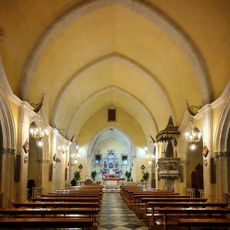
San Gemiliano, Romanesque church in Sestu, Italy.
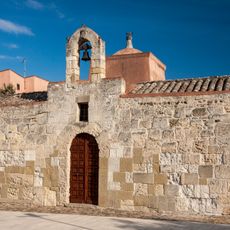
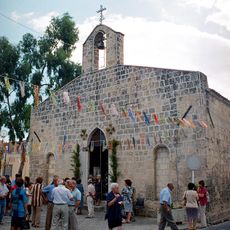
San Gemiliano is a Romanesque church in the countryside of Sestu, built by the Vittorini of Marseille. Its facade has two architraved portals and a bell gable; inside, two unequal naves each have their own entrance portal and apse, the northern nave being wider than the southern one.
San Gemiliano was built in the 13th century by the Vittorini of Marseille in French Romanesque style, near an Eneolithic settlement. It was named after Bishop Gemiliano, martyred under Hadrian in 125 AD according to his passio. In the 16th century a large portico was added to shelter the faithful.
The church is called cresia de Santu Millanu in Sardinian, and its feast is held on the third Sunday of May and the first Sunday of September. During the celebrations the outer enclosure shelters the is istalis, the traditional structures used for the festivities.
The church stands in the countryside of Sestu, near the site of an Eneolithic settlement. A 16th-century portico shelters the faithful from bad weather, and the outer enclosure hosts the 'is istalis' during the saint's festivities. The feast is held on the third Sunday of May and the first Sunday of September.
The 16th-century portico was built to shelter worshippers from bad weather, and it is the only porch the sources record. The church stands near an Eneolithic settlement, and in the 18th century an agricultural estate run by the clergy managing the church kept livestock and cultivated and grazing land.
The community of curious travelers
AroundUs brings together thousands of curated places, local tips, and hidden gems, enriched daily by 94,677 contributors worldwide.