Santa Maria Assunta, Neoclassical church in Valdobbiadene, Italy.
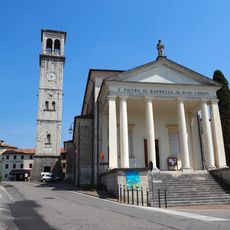
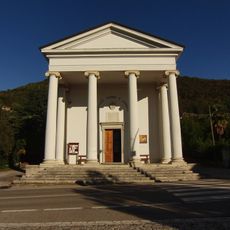
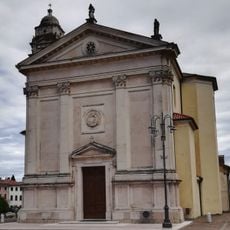
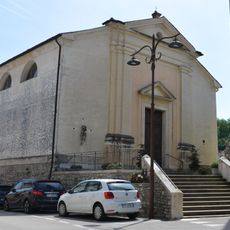
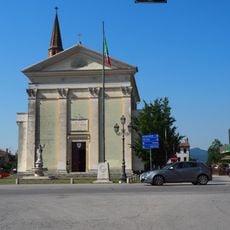
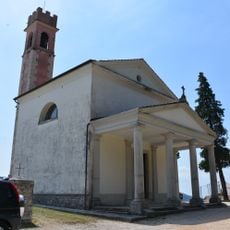
Santa Maria Assunta is a neoclassical church rebuilt between 1790 and 1799 and consecrated in 1816. Its gabled facade is preceded by a four-column Doric portico, and three statues of Saint Prosdocimus, Saint Venantius and Pope Benedict XI stand above the triangular pediment. A 70-metre square bell tower rises nearby, topped by an onion dome on an octagonal drum.
The first documented mention of the pieve dates to a Venetian testament of 18 July 1259, with a second reference in 1297. Rebuilt with a single nave, it was consecrated on 11 July 1529 by Bishop Girolamo De Sanctis. The present church was built between 1790 and 1799 and consecrated in 1816 by Bishop Francesco Scipione Dondi dall'Orologio; the atrium was added between 1825 and 1840, and the building was restored after damage in World War I.
The church serves as the spiritual center of Valdobbiadene, where the local community gathers for weddings, baptisms, and religious holidays throughout the year. Weekly masses and important liturgical celebrations bring residents together in this shared sacred space.
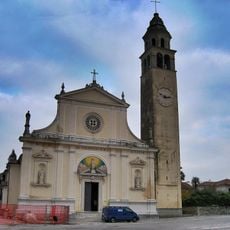
The church stands in Valdobbiadene's centre, a short walk from Piazza Marconi. The 70-metre bell tower rises on a high battered base a few metres from the parish church, with a belfry opening on each side and an onion dome on an octagonal drum. Three bells cast by Pietro Colbachini of Bassano del Grappa in 1921 hang in the tower; the largest, 157 cm across and weighing 2300 kg, rings the Angelus daily.
The bell tower, built between 1743 and 1767 and topped with a cupola added in 1810, holds three bells cast in 1921 by the Pietro Colbachini foundry of Bassano del Grappa. The largest, 157 cm across and weighing 2300 kg, sounds the angelus every day.
The community of curious travelers
AroundUs brings together thousands of curated places, local tips, and hidden gems, enriched daily by 94,524 contributors worldwide.