Casa di Niccolò Paganini, Renaissance birthplace of violinist in Genoa, Italy
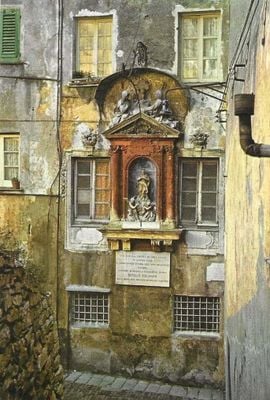
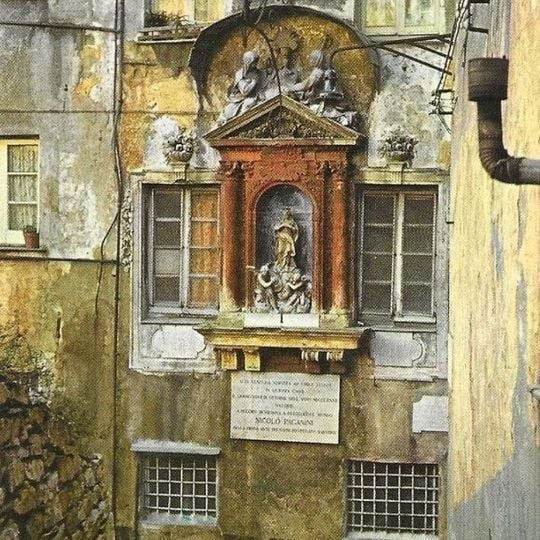
The Casa di Niccolò Paganini survives only as a flat painted facade section in Passo di Gattamora, holding a niche shrine. At its centre a tall aedicule with two reddish-brown columns and a triangular pediment frames an arched niche with a pale figure group; above the pediment a curved recess holds three more sculpted figures. Two paned rectangular windows flank it, and a white stone plaque hangs below between two small grilled basement windows.
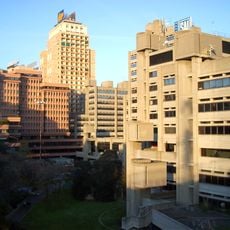
Niccolò Paganini was born in this house on 27 October 1782 and lived here until he moved to Parma at fourteen. The building, in Passo di Gattamora in the Colle district, was demolished on 13 September 1971 for the Centro dei Liguri project, leaving only the ground-floor facade with its 1610–1620 niche. The plaque placed by the municipality for the centenary of his birth was later moved to the Giardini Baltimora.
The house was demolished in 1969 and 1971; only the facade with its 1610-1620 aedicule was kept, then that too was razed. The plaque dictated by Anton Giulio Barrili for the 1882 centenary was found in a municipal warehouse and moved to the Giardini Baltimora, where the city added a second plaque in 1992. The Madonna Immacolata statue from the votive niche is now in the Museo di Sant'Agostino.
The house no longer exists: it was demolished on 13 September 1971, and only the 1610-1620 aedicule with its niche survives, set into a modern building. The white plaque with "NICOLÒ PAGANINI" and "A FECE RICOSTRUIRE A PERPETUA MEMORIA" now stands in the Giardini Baltimora, and the Madonna Immacolata statue from the votive niche is in the Museo di Sant'Agostino. Look for the facade fragment near Via Madre di Dio in the Colle district.
The house was demolished on 13 September 1971 with sledgehammers and pickaxes, leaving only the ground-floor facade with its 1610-1620 aedicule. The white plaque dictated by Anton Giulio Barrili was later found in a municipal warehouse and moved to the Giardini Baltimora, where the city added a second plaque in 1992.
The community of curious travelers
AroundUs brings together thousands of curated places, local tips, and hidden gems, enriched daily by 93,124 contributors worldwide.