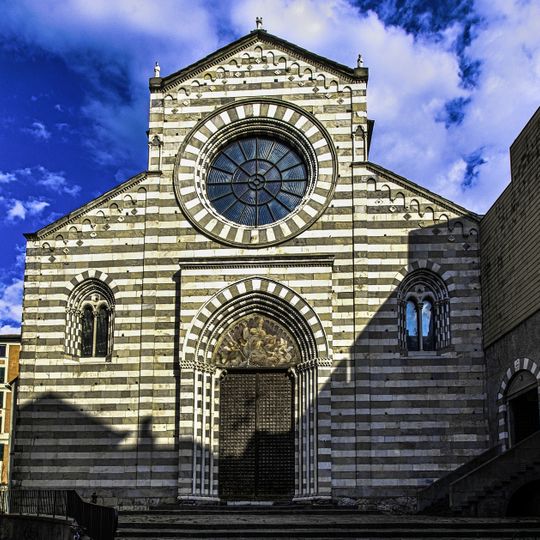
Sant'Agostino Church, Former church in the Molo district, Genoa, Italy
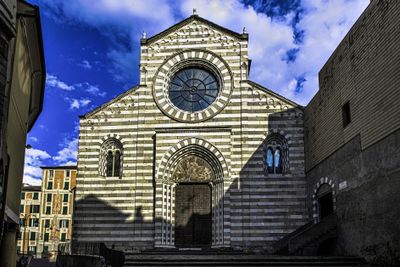
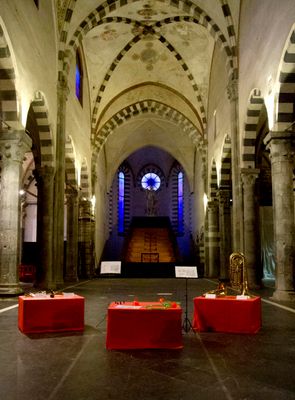
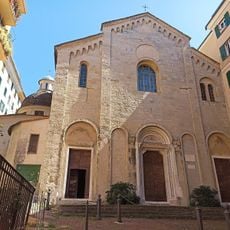
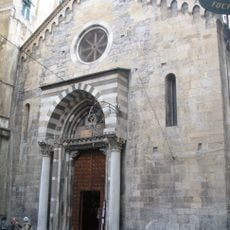
Sant'Agostino is a former church on Piazza Renato Negri in Genoa's Molo quarter, built from 1260 for the Augustinians. Its facade alternates white marble and dark Promontorio stone in horizontal bands, with a pointed portal, a large rose window and copies of three fourteenth-century statues. Inside, three naves are divided by pointed arches on stone columns with cubic capitals.
Construction began in 1260, making it one of the few surviving Gothic structures in Genoa after numerous medieval buildings were demolished during the nineteenth century. Its preservation provides rare evidence of religious architecture from that era in the city.
The church was founded around 1260 by Augustinian friars but was popularly called Sant'Agostino after the order, while its official dedication was to Saint Thecla. In 1270 the captains of the people Oberto Spinola and Oberto Doria were appointed here, and in 1339 the election of Simone Boccanegra as first doge is linked to the church. The two Oberti decreed that on the feast of Saints Simon and Jude (28 October) the magistrates should offer wax and a pallium, a tradition abolished in 1402 by Marshal Boucicault.
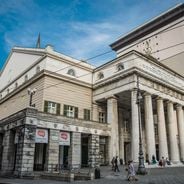
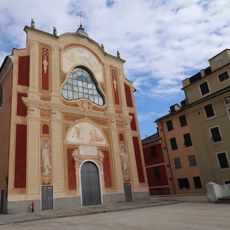
The complex occupies the top of the Sarzano hill, with the museum entrance on Piazza Sarzano and the church facade on Piazza Renato Negri; the Teatro della Tosse stands on the same square. The church itself is used as an auditorium, so it is generally entered for performances and events rather than as an open monument.
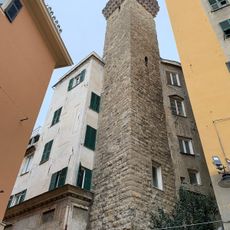
The bell tower on the right side of the transept is unusual for Genoa: a brick structure combined with polychrome ceramic tiles, with double and quadruple arched windows and a conical top with corner pinnacles. A surviving inscription names "Pietro Bono, master of Antelamo" and the date 1282, key evidence for the thirteenth-century building history.
The community of curious travelers
AroundUs brings together thousands of curated places, local tips, and hidden gems, enriched daily by 93,123 contributors worldwide.