Saint Valentine hermitage, Catholic hermitage in Gargnano, Italy.
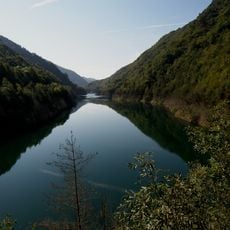
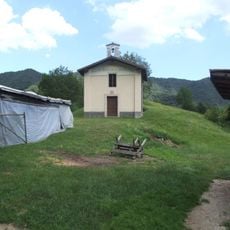
Saint Valentine hermitage stands at 772 metres above Gargnano, against the mountain face above Lake Garda. A wooden door hidden in the vegetation, opened by a stone tied to a rope running over a pulley, leads to a short path and a terrace ringed by cypresses. The complex comprises a chapel, sacristy, two rooms, a storeroom and a natural cistern once fed by a spring.
During the 1630 plague, the inhabitants of Gargnano took refuge in the mountains near Sasso; after the epidemic ended, around 1650 the survivors built a chapel with a hermitage. A hermit is documented in 1684, and Giovanni Marchetti in the mid-18th century. The last hermit, Geremia Paladini, lived there for sixteen years until his death in 1865. After falling into ruin, the hermitage was restored in 1970 and reopened on 14 February 1971.
The chapel displays an altar painting of the Madonna and Child alongside a portrait of Geremia Paladini, the final hermit who lived there from 1849 to 1865. This imagery preserves the memory of the people who made this place their spiritual home across generations.
Access is via a forest path starting from the hamlet of Sasso and requires sturdy walking shoes and water supplies for the climb. Arriving early in the morning helps avoid the strong sun on the return journey.
The wooden entrance door is hidden in the vegetation and opened by pulling a stone tied to a rope that runs over a pulley. Inside, the altarpiece is a Madonna and Child painted in 1859 by the hermit Geremia Paladini, who included himself in the scene with tunic and staff, begging at the Madonna's feet beside Saint Valentine.
The community of curious travelers
AroundUs brings together thousands of curated places, local tips, and hidden gems, enriched daily by 94,030 contributors worldwide.