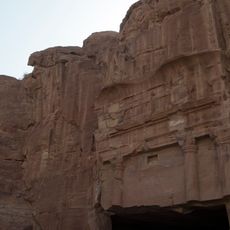
Ad Deir, Rock-cut tomb in Petra, Jordan
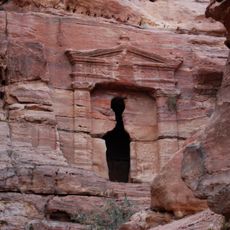
Ad Deir is a rock-cut tomb carved from sandstone with a multi-story facade topped by a stone urn ornament. A large doorway leads into a square interior chamber with a deeper wall niche, showing the straightforward layout inside.
Carved probably in the mid-1st century AD, the Deir is dated by J. Starcky to the last years of the Nabataean king Rabbel II Soter, on the basis of its resemblance to the Library of Celsus at Ephesus. An inscription found in 1991 in a niche above a cistern opposite the Deir names a mrzh' of the god Obodat, suggesting a cult site. Incised crosses in the chamber and a Greek epigraph on the facade, seen by Burckhardt in 1812 and gone by 1865, mark later Christian use.
The Arabic name means 'the Monastery', though the building was not a monastery when carved. Greek Orthodox hermits and cenobites later lived among Petra's ruins, and incised crosses remain on the interior walls. An inscription found in 1991 in a niche opposite the monument mentions the mrzh' of Obodat, a private religious group.
The climb up requires sustained hiking on a steep path through sandstone cliffs, so good footwear is essential. Going early in the day or later in the afternoon helps avoid the intense heat.
A Greek inscription once ran along the entablature of the facade; Johann Ludwig Burckhardt saw it in 1812, but it had vanished by 1865. Inside, crosses are cut into the chamber walls, and a rock-cut altar points to later Christian use as a monastery.
The community of curious travelers
AroundUs brings together thousands of curated places, local tips, and hidden gems, enriched daily by 93,111 contributors worldwide.