Fudō-in Temple, Buddhist temple in Higashi-ku, Hiroshima, Japan
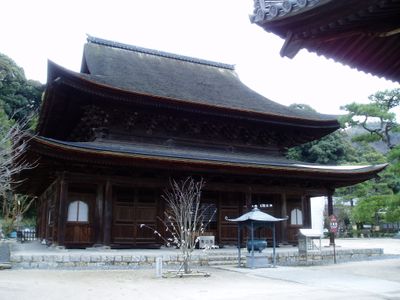
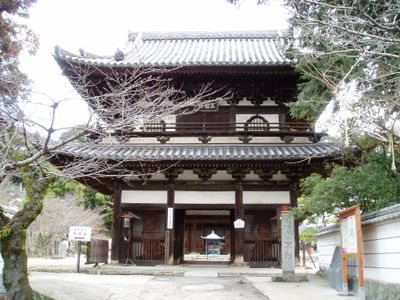
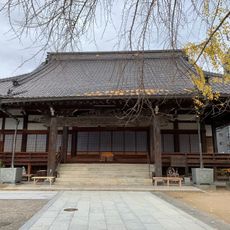
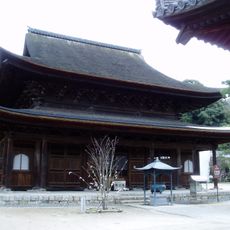
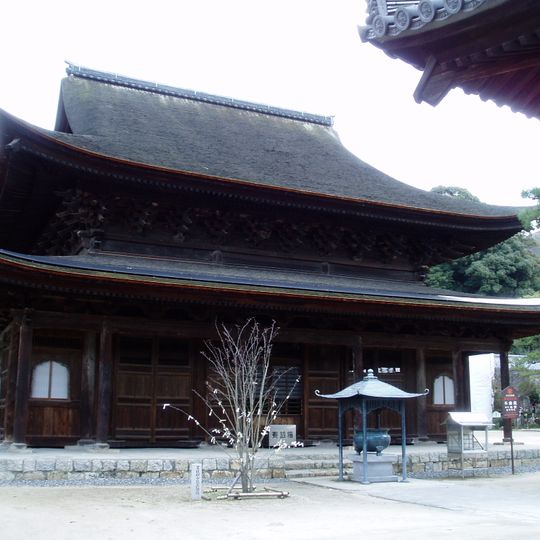
Fudō-in is a Shingon Buddhist temple whose main hall (kondō) has a steeply pitched, dark grey thatched roof with upturned corners and a dark timber facade divided into bays. The two-storey gate (rōmon) has a dark tiled roof, a white plaster upper storey with a railed balcony, and an open central passage containing a metal lantern.
The site was founded as one of the Ankoku temples commissioned by the Ashikaga clan during Japan's feudal period. The main hall was relocated here in the 16th century from another region and has endured significant upheaval since then.
The temple's name comes from Fudō Myōō, the deity chosen as main image when the site switched from Zen to Shingon Buddhism under abbot Yōchin. The bronze bell, cast in Korea in the early Koryŏ period, was brought back by the priest Ankokuji Ekei at the end of the 16th century and carries reliefs of four heavenly nymphs.
The temple is accessible by public transit and lies within walking distance of a nearby station in an urban neighborhood. Visitors benefit from wearing comfortable shoes since exploring the grounds requires walking and taking time to observe the buildings and spaces.
The kondō was built in 1540, as an ink inscription on its ceiling records, and was moved to Fudō-in from Yamaguchi's Kōryū-ji (now Rurikō-ji) during the Tenshō era by the priest Ankokuji Ekei. It is the largest surviving Zen-style hall in Japan, and the 1945 blast, 3.9 km away, tore off part of its roof and bent one pillar.
The community of curious travelers
AroundUs brings together thousands of curated places, local tips, and hidden gems, enriched daily by 93,156 contributors worldwide.