National Museum of Nature and Science, Science and natural history museum in Ueno Park, Tokyo, Japan
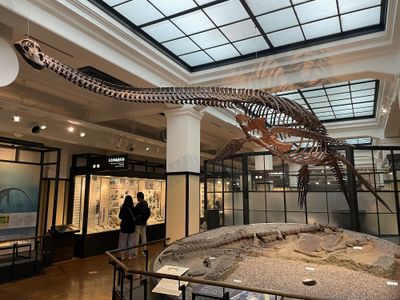
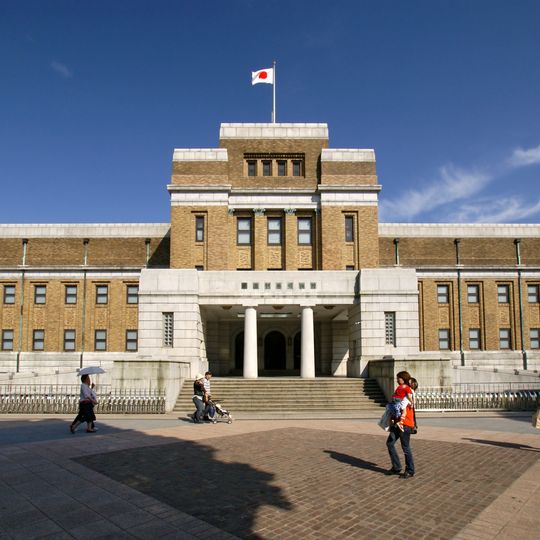
The National Museum of Nature and Science occupies a Neo-Renaissance building of pale brown brick with grey stone trim, its central section rising above two long wings. Four round columns support a projecting portico with six small square panels above, reached by a broad flight of steps. Inside, a gallery hall holds a suspended baleen whale skeleton above a smaller four-legged skeleton, with illuminated cases along the walls.
The museum traces its origin to 1872, when a museum was set up inside Yushima Seido; it counts its founding from 1877, when the Education Museum opened near Ueno. In 1931 the Neo-Renaissance main building by Ministry of Education engineer Kenzo Kasuya was completed as the Tokyo Science Museum, part of reconstruction after the Great Kanto Earthquake. It was transferred to the national government in 1949 and took its present name in 2007.
The nickname Kahaku shortens Kokuritsu Kagaku Hakubutsukan, and the museum is also called Kagaku. Its collection holds 5,004,294 items (FY2022), of which about 14,000 are on permanent display; the rest are kept and studied at the Tsukuba site. The dogs Hachikō, Taro and Jiro are preserved here as taxidermies.
The Ueno Main Building stands at 7-20 Ueno Park, Taito Ward, a short walk from Ueno, Keisei Ueno and Uguisudani stations. Exhibitions occupy the Japan Gallery and the Earth Gallery; the Japan Gallery has three floors above ground and one below. The 1931 building was engineered to withstand a Great Kanto Earthquake-class quake.
Theater 360 shows films in a spherical room where viewers stand on a bridge inside the dome while images surround them from all sides. The projection spans 12.8 meters (42 feet) and creates the feeling of floating inside the image space.
The community of curious travelers
AroundUs brings together thousands of curated places, local tips, and hidden gems, enriched daily by 92,323 contributors worldwide.