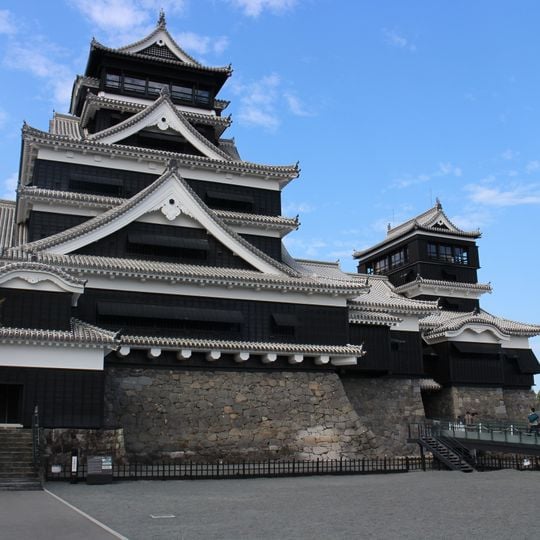
Kumamoto Castle, Castle in Chūō-ku, Kumamoto, Japan
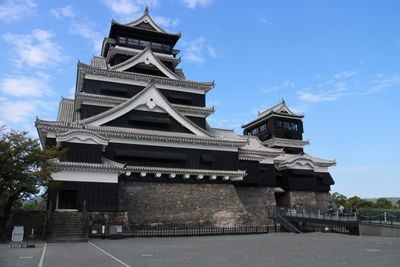
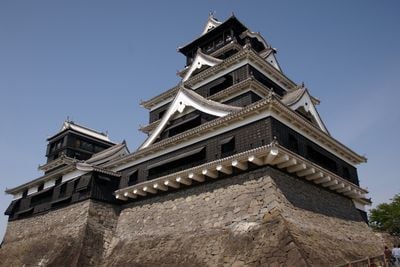
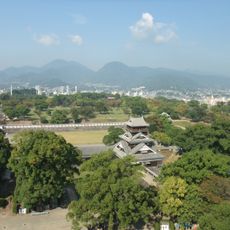
Kumamoto Castle is a hirayama-style castle on the Chausuyama ridge in Chūō-ku, Kumamoto. Its keep rises from a sloping base of rough grey stone blocks, above which the walls are faced in near-black rectangular panels; curved gables with white plaster trim project from the upper storeys, and white block-like brackets edge the lowest eaves. A lower attached wing repeats the black walls and white gable trim.
Kato Kiyomasa began building on the Chausuyama ridge in 1591, and the keep was finished around 1600; in 1607 the name was changed from Kumamoto to its present form. The Hosokawa family took over in 1632 and kept expanding the castle until the Tenpo era. In February 1877, before the Satsuma Rebellion assault, fire destroyed the keep and the Honmaru palace; the garrison of 4,000 under Tani Tateki then held out against 14,000 attackers.
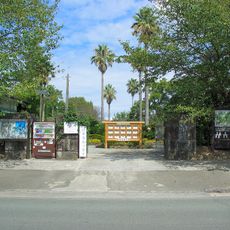
The castle is also called Ginkgo Castle: Kato Kiyomasa had ginkgo trees planted inside the walls so their nuts could feed the garrison during a siege, and dried taro stems were used for the floor mats as emergency food. The grounds are listed among Japan's top 100 cherry blossom spots, and the Sakura-no-Baba Josaien tourist complex opened at the foot of the castle in 2011.
The towers can be entered and explored inside, but the staircases are steep and wooden, and some passages have low ceilings, so comfortable shoes are a good idea. The grounds cover a large area, and walking the full circuit from the outer gates to the main keep takes a good part of the day.
Ginkgo trees were deliberately planted within the walls to provide food during sieges, since their seeds are edible. Several of these trees are still standing on the grounds today and are among the oldest living things on the site.
The community of curious travelers
AroundUs brings together thousands of curated places, local tips, and hidden gems, enriched daily by 92,170 contributors worldwide.