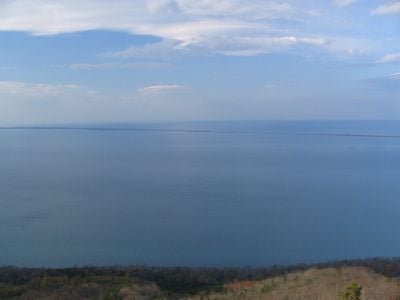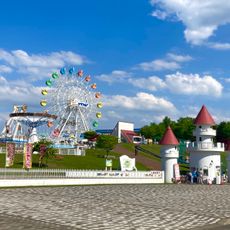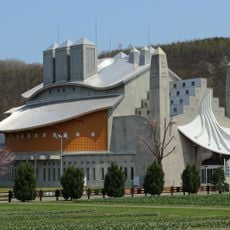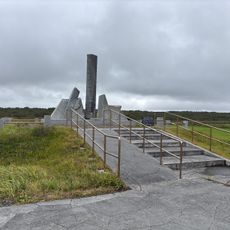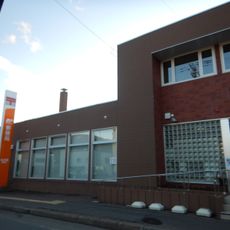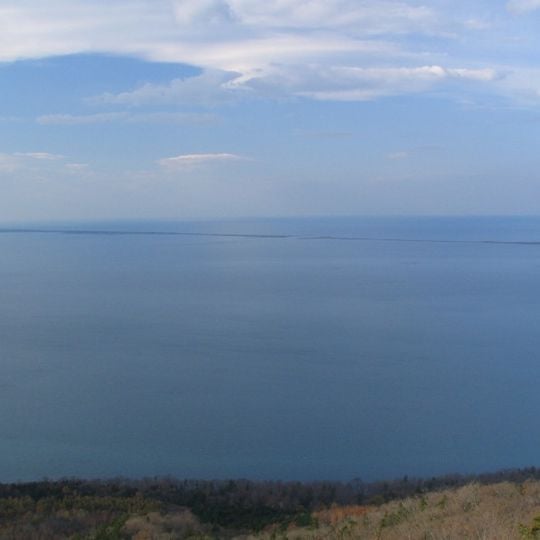
Lake Saroma, Coastal lake in Okhotsk Subprefecture, Japan.
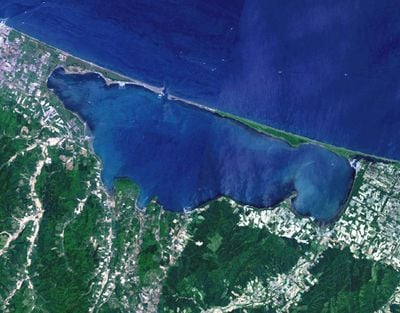
Lake Saroma is a brackish lagoon in Abashiri Quasi-National Park, spanning about 152 square kilometers across Saroma, Kitami and Yūbetsu, making it Japan's third-largest lake and Hokkaidō's largest. A 26-kilometer sandbar separates it from the Sea of Okhotsk, and two artificial channels, the First and Second Lake Mouths, cut through this bar. The lake bottom is divided into two basins by a shallow area near Cape Kimuaneppu.
The area around the water became a permanent settlement in 1894 when Jingorou Suzuki built the first Japanese homestead near what is now Hamasaroma. Before that, the Ainu used the shores for seasonal fishing and gathered materials from the reed belts without establishing fixed villages.
The name derives from the Ainu place name Saruomahetsu, meaning "place of many Miscanthus reeds and rushes"; it originally referred to the Saromabetsu River, one of the inflowing streams, while the lake itself was simply called tō (lake). The katakana form Saroma-ko is now the usual spelling, though Saroma-ko and Sarubetsu-ko also appear in older writing.
Fishing spots line the shore, with different species available depending on the season and section. Many points can be reached by car or bicycle, and some paths lead straight to the water and work well for less experienced visitors.
The two channels linking the lake to the Sea of Okhotsk were both cut by hand. The western one opened in April 1929 after Yūbetsu residents dug a channel about 7.2 m wide; it widened within days to over 100 m and by 1932 reached at least 460 m. The second channel, roughly 300 m long, was dug from 1973 and opened in 1979.
The community of curious travelers
AroundUs brings together thousands of curated places, local tips, and hidden gems, enriched daily by 92,813 contributors worldwide.