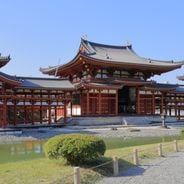
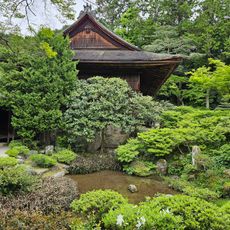
Shugaku-in Imperial Villa, Imperial villa in Sakyo-ku, Kyoto, Japan.
Shugaku-in Imperial Villa spreads over 54 hectares at the foot of Mount Hiei, split into three tea-house gardens: the Lower Garden with the Jugetsu-kan hall, the Middle Garden with the Rakushi-ken and Kyaku-den, and the Upper Garden, whose centre is the artificial Yokuryu Pond held by a 13-metre dam. The Lower Garden's Jugetsu-kan has three main rooms of 15, 12 and 5 tatami mats, and the Upper Garden's Kyusui-tei is an 18-mat single room on an island in the pond.
A former emperor commissioned the property in 1655 as a personal retreat from state duties, with final construction completed in 1659. The project reflected a broader pattern of imperial estates built outside the capital during this era.
The name Shugaku-in comes from a temple that once stood nearby, not from the villa itself. The Middle Garden's Kyaku-den holds the Kasumi-dana, a zelkova-wood shelf ranked with the Katsura and Daigo-ji shelves as one of Japan's three great shelves. Its sliding-door paintings of fish include a net, said to have been added after the fish swam out at night.
Visitors must request advance permission from the Imperial Household Agency and can only explore the property through guided tours lasting around one and a half hours. The best visiting times are seasons with mild weather, since much of the tour takes place outdoors.
The paddy fields between the three tea houses were bought by the Imperial Household Agency in 1964 and are still farmed under contract by local farmers. The pine-lined paths linking the gardens began as footpaths between fields, widened in 1885 for Emperor Meiji's visit.
The community of curious travelers
AroundUs brings together thousands of curated places, local tips, and hidden gems, enriched daily by 93,178 contributors worldwide.