Adashino Nenbutsu-ji Temple, Buddhist temple in Saga Toriimoto, Kyoto, Japan.
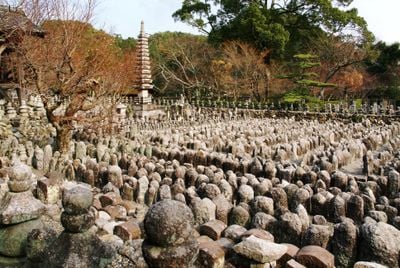
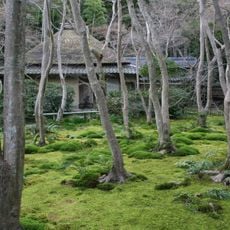
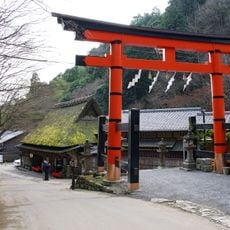
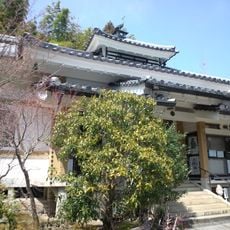
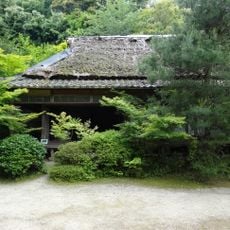
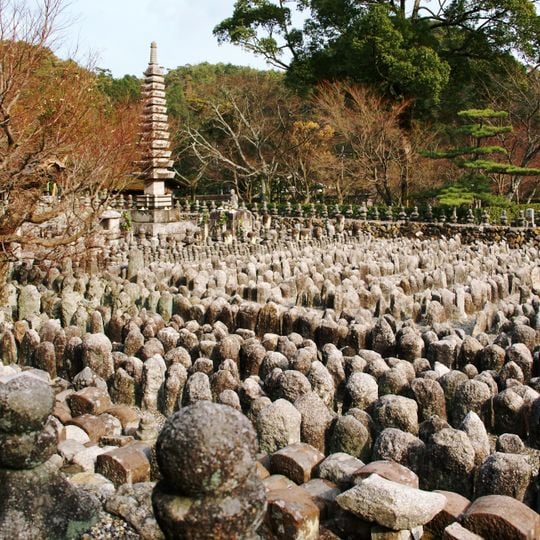
Adashino Nenbutsu-ji is a Jodo sect temple at Saga-Toriimoto, Ukyo Ward, Kyoto, on a hillside in the Adashino area. Its main hall, rebuilt in 1712, stands among a bell tower, Jizo halls and a bamboo grove. Around a thirteen-tiered stone pagoda, some 8,000 stone Buddhas and pagodas are packed shoulder to shoulder, and a stupa modelled on Sanchi was added in 1969.
In 811 the monk Kūkai is said to have buried remains left exposed at Adashino and set up a thousand stone Buddhas with five Wisdom Buddhas, founding Gojizan Nyorai-ji. Hōnen later opened a nenbutsu practice hall there, and the temple took the name Nenbutsu-ji. In the Meiji 30s (around 1903) Nakayama Tsūyū of the Fukudenkai group dug up neglected buried images and arranged them as hearers of the Buddha's treasure-tower sermon.
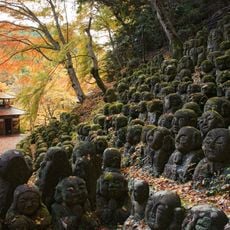
Adashino is a place name, while nenbutsu refers to the recitation of a buddha's name. The rows of stone figures are called Sai no Kawara, after the riverbank where children pile stones, as described in Kuya's Jizo Wasan. On the evenings of 23 and 24 August, the Sento Kuyo ceremony lights about ten thousand statues with candles.
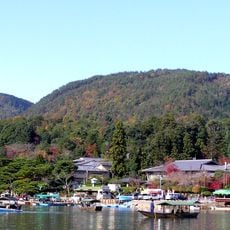
The grounds sit uphill from the central Sagano area and visitors reach them on foot after a twenty-minute walk through quiet neighborhoods and green paths. The route rises gently and requires comfortable shoes and some time to walk.
The stupa in the grounds is a replica of the Sanchi Stupa in Madhya Pradesh, India, a World Heritage Site, and was built in 1969. It is not a reliquary for bones; the roughly 8,000 stone figures around it were dug up and gathered in the Meiji 30s by Nakayama Tsuyu, founder of the Fukudenkai group.
The community of curious travelers
AroundUs brings together thousands of curated places, local tips, and hidden gems, enriched daily by 93,240 contributors worldwide.