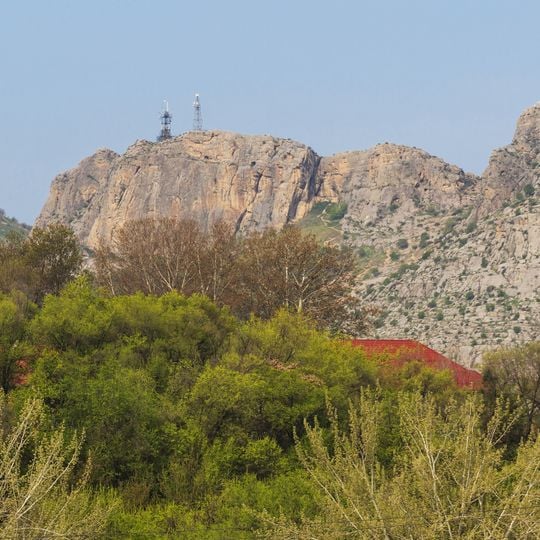
Sulaiman-Too, Sacred mountain in Osh, Kyrgyzstan.
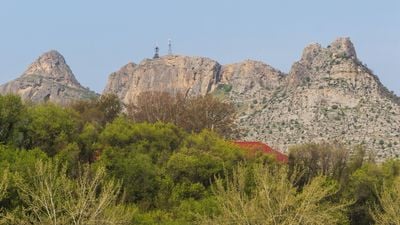
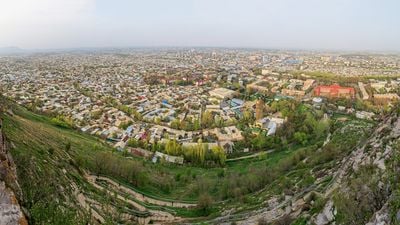
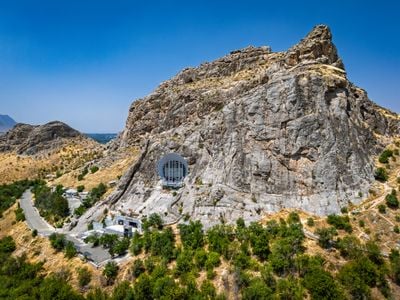
Sulaiman-Too is a five-headed limestone outcrop stretching about 1,140 metres east to west and 560 metres wide, rising 300–350 metres above Osh. Its central cliff is the highest and most continuous, with a lower shoulder to the left and two slender metal towers on the summit. The slopes are steep and rocky, with terraced paths cut into the lower bare rock.
The first written record of the mountain is in the 10th-century work of the Arab geographer al-Istakhri, who describes guards posted on it to watch for Turkic groups. A Kufic inscription found on the summit names the Samanid ruler of Fergana Nasr ibn Ahmad and dates to 940–941. Until the 16th century the mountain was called Bara-Kuh, then Takht-i-Sulaiman. The summit mosque, attributed to Babur's reign, was blown up in 1963 and rebuilt in 1991 with funding from Pakistani prime minister Benazir Bhutto.
Pilgrims still climb to the summit mosque, rebuilt in 1991 with funding from Pakistani prime minister Benazir Bhutto on the site of an earlier mosque blown up in 1963. At Babur's House, rebuilt in 1989, mullahs recite the Quran for visitors. Women pray at the Khurkiz cave, men at Kyrk Chilton, and childless couples at Beshik Ene.
The walk up the mountain usually takes about thirty minutes on foot and requires sturdy shoes because of the rocky terrain. It is advisable to bring water and avoid climbing during the hottest hours of the day, as there is little shade at the top.
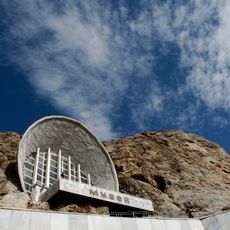
The largest cave, Rusha-Unkur on the third summit, now holds a museum whose halls trace southern Kyrgyzstan's history; petroglyphs survive at its exit. The cave's name means "eagles' cave."
The community of curious travelers
AroundUs brings together thousands of curated places, local tips, and hidden gems, enriched daily by 94,046 contributors worldwide.