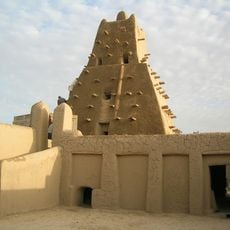
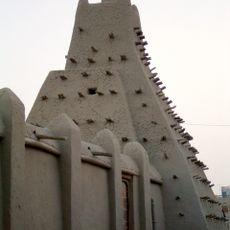
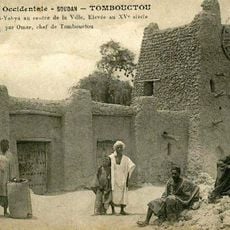
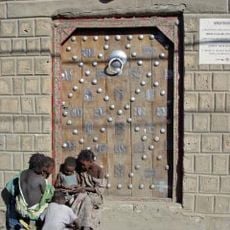
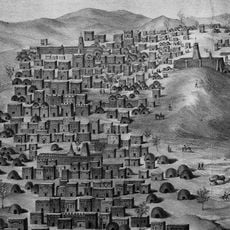
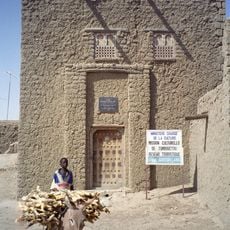
Djinguereber Mosque, Saharan mosque in Timbuktu, Mali.
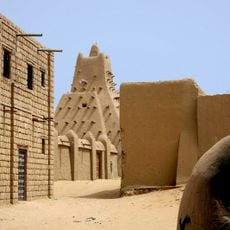
Djinguereber Mosque is a Sudano-Sahelian mosque in Timbuktu, Mali, built mainly of earth with fibre, straw and wood. Its tapering, rounded tower is studded with projecting wooden beams (torons), and a crenellated parapet with rounded battlements tops the walls. Inside are three courtyards, two minarets and twenty-five rows of pillars aligned east-west, giving space for 2,000 worshippers.
Mansa Musa is credited with founding the mosque in 1325, and it was built in 1327. The Andalusi scholar Abu Ishaq al-Sahili is traditionally credited with its design, said to have been paid 12,000 mithkals of gold dust, but recent analyses reject this and derive the style from Saharan and West African building. Qadi Aqib ibn Mahmud renovated it from 1570 under Askia Dawud.
The name comes from Koyra Chiini jiŋgar-ey beer, "grand mosque". It is one of the three mosques of the community of scholars known as the University of Timbuktu, and Mawlid is still observed here; a stampede during the 2010 Mawlid procession killed about 26 people.
The earthen structure requires regular community maintenance, with new layers of mud applied annually to protect against sand erosion and rainfall damage. Visitors should expect that restoration work may be visible during their visit.
The building incorporates architectural elements from different regions, featuring pyramid-shaped minarets with projecting wooden beams that serve as permanent structural supports. These wooden elements are integral to the original design rather than temporary additions.
The community of curious travelers
AroundUs brings together thousands of curated places, local tips, and hidden gems, enriched daily by 94,623 contributors worldwide.