Aso Rock, Mountain peak in Federal Capital Territory, Nigeria
Aso Rock is a granite outcrop on the outskirts of Abuja, rising 400 metres above the surrounding land to a peak of 936 metres above sea level. Its lower slopes carry trees and shrubs, while the upper face is bare grey-brown rock with vertical streaks and grooves. The crest is uneven, highest near the centre, and two tall lattice masts stand in front of the lower slopes.
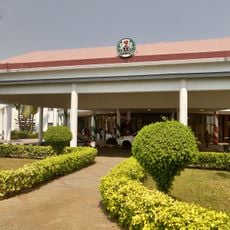
Aso Rock is a granitic outcrop on the outskirts of Abuja. In 1991 the administration of President Ibrahim Babangida founded Aso Villa there, the same year Nigeria's capital moved from Lagos to Abuja. The presidential residence stands within the Nigerian Presidential Complex, beside the National Assembly and the Supreme Court. In 2003 the rock gave its name to the Aso Rock Declaration, issued by Commonwealth heads of government at the CHOGM held in Abuja.
In the Gbagyi dialect, the mother tongue of the Asokoro, "Aso" means victorious. The rock and the caves inside it hold a high cultural status, with many myths and legends told about them. The Asokoro themselves were displaced from the area.
The rock is visible from many vantage points across the city and serves as a natural landmark while exploring the government district where the National Assembly and Supreme Court are located. Visitors should be aware that some areas of the rock may have restricted access, so it is wise to check local conditions before planning a visit.
Aso Rock is the highest point in Abuja, rising 400 metres above the surrounding land to 936 metres above sea level. The presidential villa, National Assembly and Supreme Court were placed around its base after the capital moved from Lagos in 1991. The rock and the caves within it carry a high cultural status among local communities, with many myths and legends attached to them.
The community of curious travelers
AroundUs brings together thousands of curated places, local tips, and hidden gems, enriched daily by 94,692 contributors worldwide.