Preikestolen, cliff in Strand Municipality, Rogaland, Norway
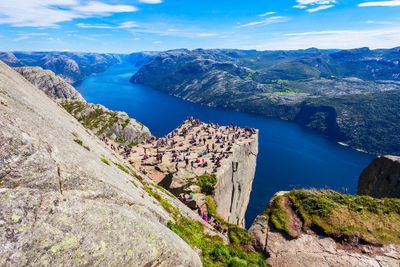
Preikestolen is a granite cliff rising 604 meters above Lysefjord in Norway. At the highest point lies a flat plateau where you can stand and look down while the rock walls around drop vertically and the water shimmers far below.
The cliff was formed about 10,000 years ago during the Last Glacial Period, when water froze in crevices and broke off angular blocks that the glacier carried away. The old local name was Hyvlatonnå; the name Prekestolen was coined around 1900 by Stavanger Turistforening to promote trekking, and an 'i' was later added to match Nynorsk.
The name means Pulpit Rock, from the flat 25-by-25-metre top that resembles a raised pulpit. The old local name was Hyvlatonnå, 'the plane's tooth'; the tourist association Stavanger Turistforening coined Prekestolen around 1900, and the 'i' was added later to match Nynorsk.
The hike starts at Preikestolhytta, about 270 metres above sea level, and climbs to 604 metres over roughly 3.8 kilometres each way; the elevation difference is 334 metres, but the path repeatedly rises and descends ridges, so the total gain is greater. Allow 2–3 hours up and 3–4 hours round trip for average fitness. Snow and ice can make the trail difficult in winter and spring, and the plateau itself has no railing.
Wide cracks run through the granite and suggest the rock might break off one day, but geologists say the structure has remained stable for ten thousand years. Sherpas from Nepal helped improve the trail in 2013 and applied techniques they know from the Himalayas.
The community of curious travelers
AroundUs brings together thousands of curated places, local tips, and hidden gems, enriched daily by 92,356 contributors worldwide.