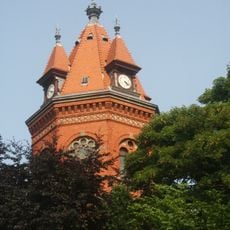
Wiechert Palace in Starogard Gdański, Eclectic palace in Starogard Gdański, Poland.
Wiechert Palace consists of two connected wings. The western wing, built in 1882, is a single-storey red-brick structure in Neo-Classical style. The south-eastern wing, added in 1893, rises two storeys in Neo-Renaissance style and forms the palace's representative front. The eclectic front facade is adorned with sculptures of five women, one of them a copy of Venus Italica carved in red sandstone.
In 1880 the merchant Franciszek Wiechert, who had bought the town's water mill in 1871, built a residential and administrative complex around it, including the family's palace. The Wiecherts kept the property until early 1945; after the war it passed to the state, which used it for a kindergarten, a nursery and housing for mill workers. It is now privately owned and was entered in the monument register in 1996.
The name recalls the Wiechert family, who kept the palace until early 1945. On the front facade, five female figures are carved; one, a woman wrapping herself in cloth and looking abashed, is a copy of Canova's Venus Italica in red sandstone. Inside, the first-floor reception hall keeps a ceiling rosette and eclectic painting with Neo-Renaissance motifs.
The residence remains privately owned and can only be viewed from the exterior, allowing visitors to see its ornamental architecture and decorative details from surrounding public streets. The southern facade is most visible from the pathways encircling the property.
The southern facade displays five female sculptures, including a replica of Venus Italica, an artwork by Antonio Canova from 1804. These classical statues give the property a monumental artistic character.
The community of curious travelers
AroundUs brings together thousands of curated places, local tips, and hidden gems, enriched daily by 94,499 contributors worldwide.