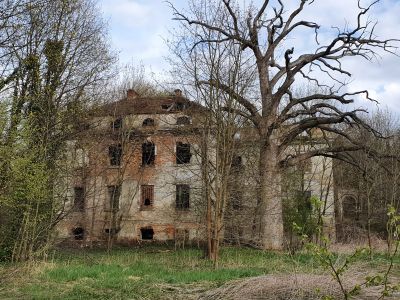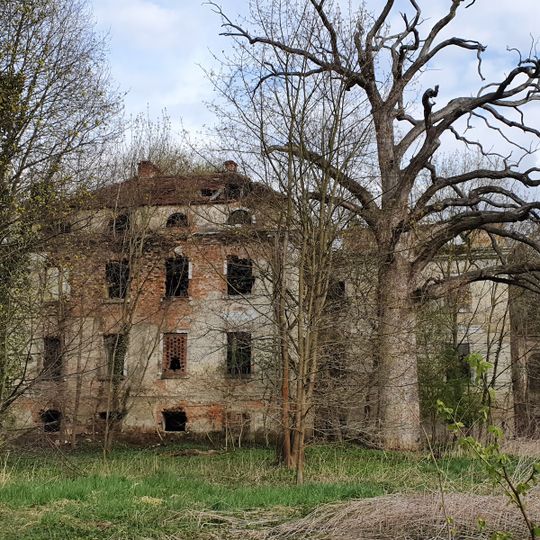
Pałac w Głębowicach, Classical palace in Głębowice, Poland
Schloss Glumbowitz is a ruined classical palace in Głębowice, built 1801–1826 probably to designs by Christian Valentin Schultze. It has three wings, two storeys plus an attic with semicircular windows, and a mansard roof. The courtyard facade has a convex risalit with an attic balustrade and a stuccoed eagle frieze with festoons.
Count Gustav von Rödern acquired the property in the late 18th century, and his son Erdmann Gustav commissioned a renovation following Christian Schultze's designs in 1804. A neo-Gothic chapel was later added to the grounds between 1862 and 1864 based on Karl Lüdecke's designs.
The estate's name appears in German as Glumbowitz and in Polish as Głębowice. The park holds a neo-Gothic mausoleum built in 1862–1864 to Karl Lüdecke's design, with the Pourtalès coat of arms in its vault; James von Pourtalès (1853–1908), his wife Berthe (1852–1905) and Agnes von Pourtalès (1830–1909) are buried there.
The estate is surrounded by a park containing an octagonal orangery, a gardener's house, and paths for exploring the grounds. Visitors should wear appropriate footwear as the area features ancient trees and natural walking paths.
The park's best-known tree is the "Ruineneiche" (ruin oak), also called the "thousand-year-old oak", with a trunk circumference of 7.84 metres. North of the palace lay ponds covering a total of 7 hectares. The park also held exotic tulip trees, magnolias and bald cypresses.
The community of curious travelers
AroundUs brings together thousands of curated places, local tips, and hidden gems, enriched daily by 94,897 contributors worldwide.