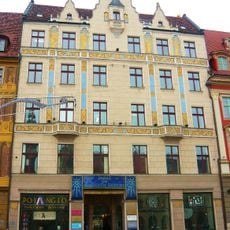
Former Mohren Pharmacy in Wrocław, Modern architectural monument in Salt Market Square, Wrocław, Poland
The Former Mohren Pharmacy is a modernist office and commercial building at Plac Solny 2/3 in Wrocław, created by Adolf Rading in 1925–1928 by merging two older townhouses. Its white facade is divided by dark horizontal bands along the window edges, and the ground floor is clad in ceramic tiles. The interior, designed with Hans Leistikow, had multicoloured rectangular tiles and mirrors.
The pharmacy on this site was first recorded in 1489, the youngest of four then operating in Wrocław. In 1924 Doris Leschnitzer commissioned Adolf Rading to rebuild the house; working with Hans Leistikow, he completed a modernist conversion in 1925. After the family bought the neighbouring house in 1927, Rading joined both buildings, finishing the present structure in 1928.
The name "Under the Moor" and the house emblem of a Moor's head were common exotic references for pharmacies in Poland and Germany. A life-size figure of a Moor, made in the late 19th century, adorned the facade at first-floor level and was often the target of students' crude jokes. Today the building houses the Wrocław office of "Gazeta Wyborcza".
The building is located at Plac Solny 2/3 in the heart of Wrocław and is easily accessible from the main streets of the old town. Its preserved exterior can be viewed from the square, and the location makes it simple to combine with other nearby landmarks.
The pharmacy kept an Egyptian mummy of a young woman, dated between 3000 and 600 BC, brought to Wrocław around the end of the 16th century by the physician and collector Laurentius Scholtz. After his death in 1599 the then owner Jacobus Krause moved it into the pharmacy, where it stayed until 1945. Residents spread a rumour that mummy powder was added to the medicines sold there.
The community of curious travelers
AroundUs brings together thousands of curated places, local tips, and hidden gems, enriched daily by 93,144 contributors worldwide.