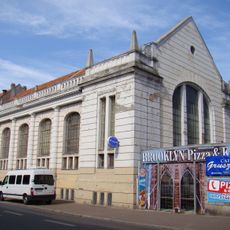
Kamienny Szaniec in Kołobrzeg, Military sconce in Kołobrzeg, Poland.
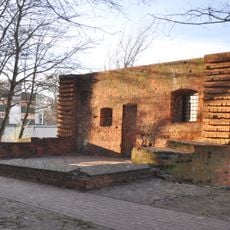
Kamienny Szaniec is a redan-shaped sconce in Kołobrzeg, built from 1832 to 1836 with two earthen ramparts, casemates, and a moat on the north and east sides. Its seaward side is protected by a massive stone embankment, from which the Polish name derives. The entrance was on the west side.
The sconce was built between 1832 and 1836 on the shore where the bloodiest fighting of 1807 took place between the defenders of Kołobrzeg Fortress and the 1st Infantry Regiment of the Poznań Legion. It guarded the fortress and port approaches and was meant to counter enemy ships. It adjoined the Wolf Fort, now an amphitheatre, forming the eastern defences. Its entrance lay on the west side.
The Polish name comes from the stone embankment of boulders that shielded the work from the sea; the German name, Waldenfels Schanze, honoured Captain Karol W. E. Waldenfels, killed in 1807 at the nearby Wolf Fort. From 1887 the moat was partly filled, trees planted, a garden restaurant built inside and a glazed veranda with terrace holding a café placed on the sea rampart.
The sconce stands on the dune belt at the Baltic shore, where Fredry Street meets Sułkowskiego and Sikorskiego streets, closing the eastern end of Stefan Żeromski Park. The former western entrance and the filled-in moat are gone, and the stone sea rampart was demolished, so the shoreline here erodes and the beach narrows; bank protection works continue around the ruins.
In 1972 the voivodeship authorities asked the Ministry of Culture and Art to remove the sconce from the heritage register, though the deletion never happened. Earlier, despite protests and without scientific consultation, the stone breakwater on the sea side was demolished, which intensified coastal erosion and the loss of the beach.
The community of curious travelers
AroundUs brings together thousands of curated places, local tips, and hidden gems, enriched daily by 94,418 contributors worldwide.