New Stock Building, Wrocław, Historical trading building in Wrocław, Poland.
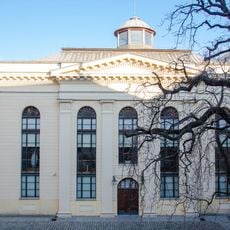
The New Stock Building (Nowa Giełda) is a three-storey brick building on a trapezoidal plan near the square, its south part rising to four storeys. Sand-coloured plaster imitates stone rustication, and a crenellated attic with corner turrets tops the four-storey section. A five-axis portico marks the main entrance, and the south facade has eight tall portfenetr windows.
Wrocław's exchange was founded in the 17th century to settle disputes between merchants and set commodity prices; brokers received their statute in 1670, and the first seat was the Old Exchange at Plac Solny 16. In 1863 a competition for a new building was won by Karl Lüdecke, whose neo-Gothic and neo-Renaissance designs were combined; construction began in 1864 opposite the provincial parliament, beside the Royal Palace.
The building was a stock exchange, not a market: brokers whose statute was adopted in 1670 settled disputes between merchants and set commodity prices there. Trade linked Wrocław with many countries of Europe and South America. The exchange hall also served as a lecture and concert hall; on 6 February 1891 Ignacy Jan Paderewski performed here, commemorated by a bronze plaque placed in 2017.
The building stands at the corner of Krupnicza and Włodkowica streets, opposite the former provincial parliament and next to the Royal Palace. Its south facade faces the promenade, where the eight tall portfenetr windows and the side entrance are best seen. The north facade is deliberately plain, so approach from the south or east for the ornamented elevations.
The sandstone figure of Trade on the front facade is a portrait of the architect Karl Lüdecke, who won the 1863 competition with two designs that were then merged. A bronze plaque added in 2017 marks Ignacy Jan Paderewski's concert of 6 February 1891 in the exchange hall.
The community of curious travelers
AroundUs brings together thousands of curated places, local tips, and hidden gems, enriched daily by 94,446 contributors worldwide.