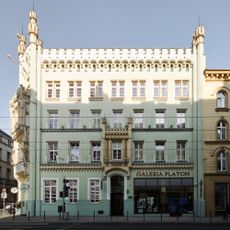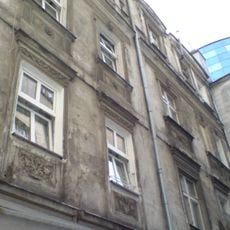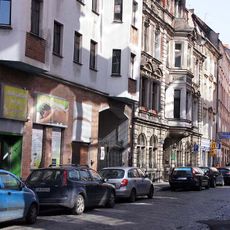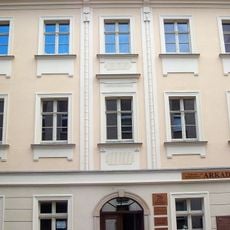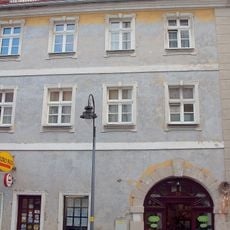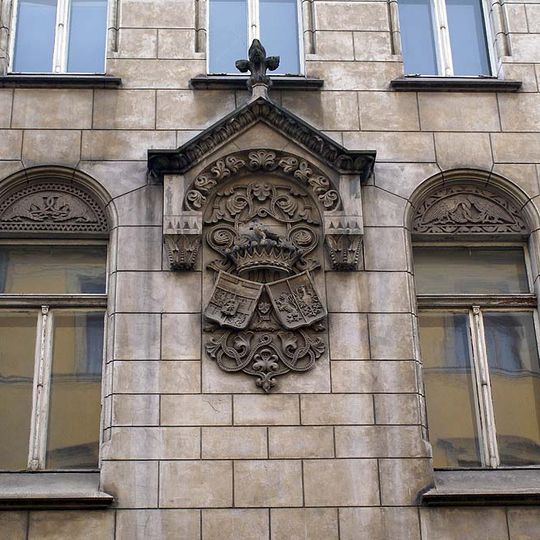
Ballestrem Palace in Wrocław, Gothic Revival palace in Włodkowica Street, Wrocław, Poland.
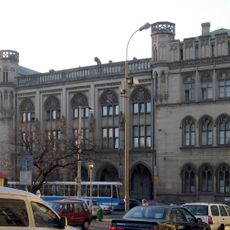
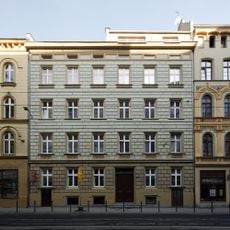
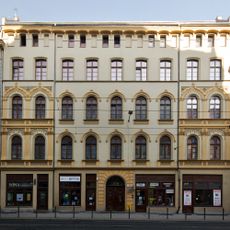
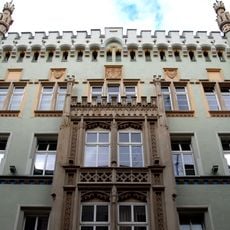
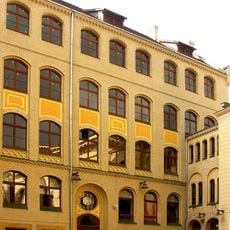
Ballestrem Palace is a mansion at Włodkowica Street 4-6, rebuilt in 1898-1899 by architect Albert Grau for Count Franz Xaver von Ballestrem. Grau gave the former director's villa a Romanesque-inspired facade with Secessionist elements, adding a third storey, a stepped gable and a belvedere. The facade is clad in rusticated stonework imitating ashlar blocks, with varied neo-Gothic window openings and a semicircular entrance arch bearing the inscription "Commutatum et renovatum An. Do. 1898". The coats of arms of Franz von Ballestrem and his wife Hedwig von Saurma-Jeltsch appear on the front facade and the garden elevation.
The palace was built in 1898 for Franz Xaver von Ballestrem, a wealthy industrialist and politician who owned mining and steel operations. Architect Albert Grau designed the structure, leaving his mark on the building through inscriptions and design choices.
The facade carries the coats of arms of Franz Xaver von Ballestrem and his wife Hedwig von Saurma-Jeltsch, married in 1858, and a statue of Saint Hedwig by Carl Franke sits in the southwest corner. Above the entrance arcade an inscription reads Commutatum et renovatum An. Do. 1898, marking the rebuilding.
The building is visible from the street and shows its facade openly to passersby. Visitors can observe the exterior details and entrance hall up close, though the private office spaces inside are not open to the public.
The medieval city walls, demolished after 1807, survive in the palace cellars, along with 18th-century flat arches, a vent that drew off gunpowder smoke and a fortified gate. An obelisk with an iron plaque commemorating the 1749 Powder Tower explosion once stood on plot no. 6.
The community of curious travelers
AroundUs brings together thousands of curated places, local tips, and hidden gems, enriched daily by 94,369 contributors worldwide.