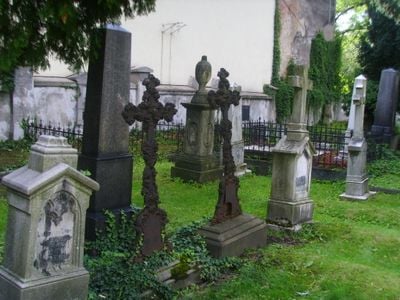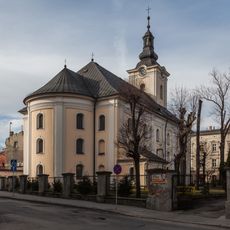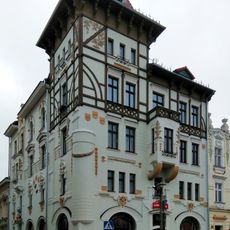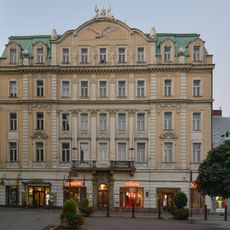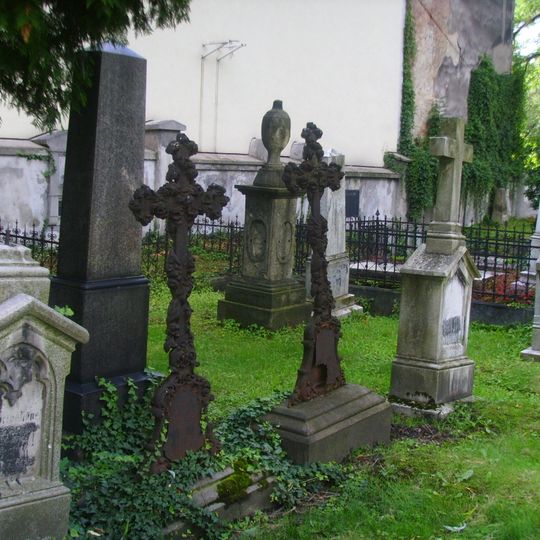
Evangelical Cemetery in Bielsko-Biała, Evangelical burial ground in Bielsko-Biała, Poland.
The Evangelical Cemetery in Bielsko-Biała occupies a trapezoid-shaped plot of 17,886 m² at Piłsudskiego 15, enclosed by a wall with two gates built around 1867. Its layout reflects two 19th-century expansions, in 1838 and 1867, and it contains the graves of factory-owning families, pastors, mayors, politicians and artists.
Consecrated on 26 June 1783, the cemetery replaced a shared Catholic-Lutheran burial ground on the site of the Martin Luther Church. The first burial was Johanna Protzner, a fifteen-day-old child, five days before the consecration. In 1838 the parish bought the Augustini Garden, and in 1867 an eastern plot was added, giving the cemetery its present trapezoid shape and wall with two gates.
The cemetery's German inscriptions were largely destroyed in 1945–1948 during the postwar "struggle against Germanness," when 75% of German-language grave inscriptions were obliterated. The few that survive, alongside Polish inscriptions, are what remain of the German-speaking Protestant elite of 19th-century Bielsko.
The cemetery lies at Piłsudskiego 15 in the city centre. Its trapezoid-shaped grounds of 17,886 m² are enclosed by a wall with two gates: the main gate on the east side and a side gate on the west, where the old entrance once stood. The layout dates from the 1867 extension.
The first person buried here was a fifteen-day-old child, Johanna Protzner, interred five days before the 1783 consecration; her gravestone reads "Der erste auf dem neuen Gottesacker" (the first in the new cemetery). The first burial with full honours was twelve-year-old Johann Gottlieb Miltsche, and the first adult, 65-year-old Johann Thomke, was buried the same day.
The community of curious travelers
AroundUs brings together thousands of curated places, local tips, and hidden gems, enriched daily by 94,527 contributors worldwide.