Sanguszko Palace, Noble residence in Tarnów, Poland.
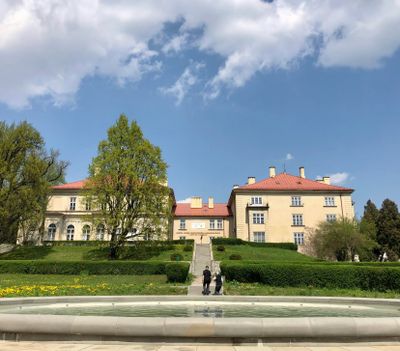
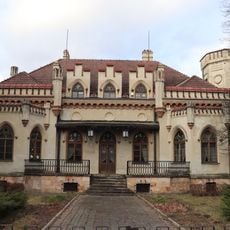
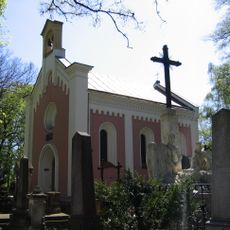
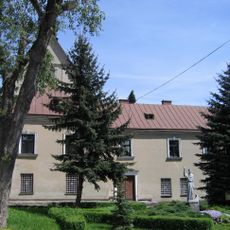
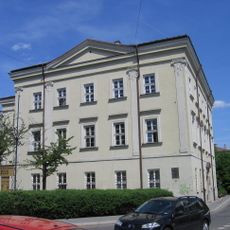
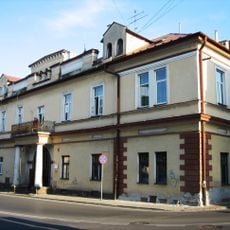
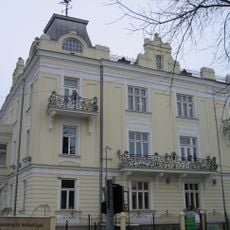
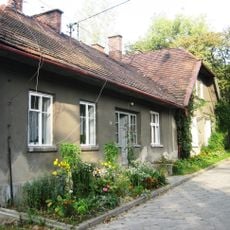
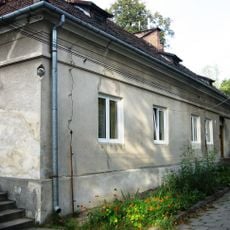
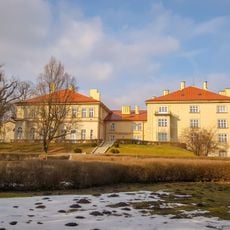
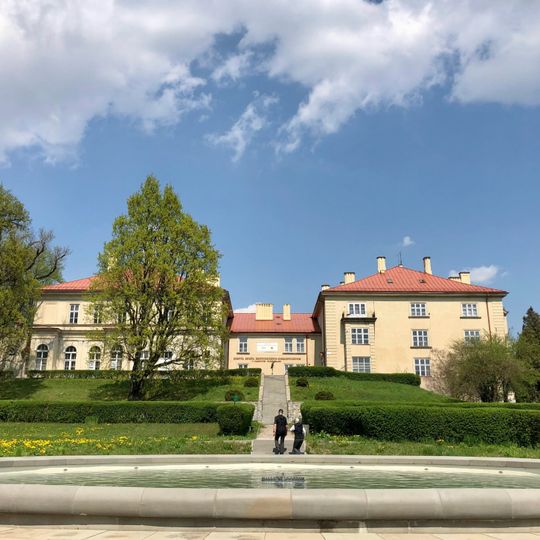
Sanguszko Palace is a C-shaped residence in Tarnów's Gumniska district, built in classicist style with eclectic elements. A two-storey east wing and a one-storey west wing are joined by a lower link with a columned portico; four Doric columns support a terrace above the entrance. A neo-Gothic chapel adjoins the west wing, and a bronze copy of Giambologna's Mercury stands on the south terrace.
Hieronim Sanguszko began a classicist summer residence here in 1799, replacing a wooden manor; his grandson Władysław added the two-storey east wing in 1834. During the January Uprising the Sanguszkos ran a hospital here for wounded insurgents, and in 1860 Paweł Sapieha, first president of the Polish Red Cross, was born in the palace. Seized during World War II and nationalised in 1945, it became a horticultural school.
The palace's name recalls the Sanguszko princes of the Pogoń Litewska coat of arms, a branch of the Lithuanian Gediminid dynasty who acquired the Tarnów estates, including Gumniska, in the 18th century. Since 1945 the residence has housed the Economic and Horticultural School Complex in Tarnów, so the former ballroom and halls now serve pupils rather than the family.
The building houses an active school complex, which may limit casual visits. It is best to check in advance about how you can view the grounds, as the site remains a working educational facility.
On the terrace south of the palace stands a bronze statue of Mercury, a copy of Giambologna's sculpture; the 1580 original is in the Bargello in Florence. In the entrance hall, a neo-Renaissance marble fireplace holds a bust of Tadeusz Kościuszko by Jerzy Popiel from 1946.
The community of curious travelers
AroundUs brings together thousands of curated places, local tips, and hidden gems, enriched daily by 93,093 contributors worldwide.