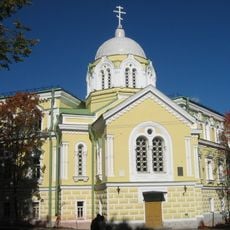
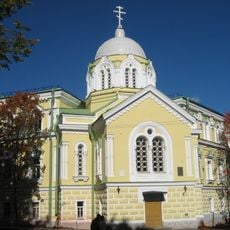
Saint Pantaleon church in Tsarskoye Selo, Orthodox church on Hospital Street in Pushkin, Russia.
Saint Pantaleon Church occupies a former hospital chapel on the grounds of City Hospital No. 38 in Pushkin. The single-storey brick building is plastered and covered with iron; its east wall is semicircular. The upper chapel measured 6.5 m high, 12.8 m long with the altar and 10.7 m wide, lit by eight windows and entered from the main staircase. A cross was installed on the dome in 2002.
The church descends from the Constantine and Helen church founded in Sofia on 22 July 1781, consecrated the same year and closed by imperial decree in 1817, when its vessels and bells passed to the hospital church. The stone hospital of 1846–1852 by architect Nikolai Nikitin received a church by Nikolai Yefimov, consecrated on 12 October 1852 to the icon "Joy of All Who Sorrow". Silvio Danini enlarged it in 1913, adding a lower church; the upper church closed on 5 February 1930, the lower on 16 August 1933. In 2001 the chapel was consecrated to Saint Pantaleon.
The chapel was consecrated in 2001 to Saint Pantaleon, a physician-martyr, after the building returned to the Russian Orthodox Church in 2000; a cross was placed on the dome in 2002. The church is attached to the Holy Sophia Cathedral of the St Petersburg eparchy. From the mid-19th century an old iconostasis stood in a hospital courtyard chapel, and its altar table was moved in 1872 to the Church of the Nativity of the Theotokos in Pushkin.
The church stands on the grounds of City Hospital No. 38 named after N. A. Semashko in Pushkin, in the former hospital chapel; it is attached to St Sophia Cathedral. Access is through the hospital territory, so visitors pass the hospital buildings before reaching the church. The upper church was long used as a conference hall, and since January 2004 a moleben is served there once a week.
The chapel in the hospital courtyard held an old iconostasis, and its altar table was moved in 1872 to the Church of the Nativity of the Theotokos in Pushkin. The chapel stood unused for its purpose, and the bell tower was closed in 1929, serving as the city morgue until 1999.
The community of curious travelers
AroundUs brings together thousands of curated places, local tips, and hidden gems, enriched daily by 94,590 contributors worldwide.