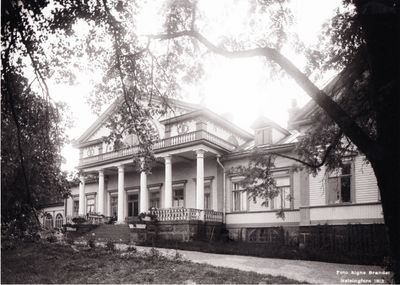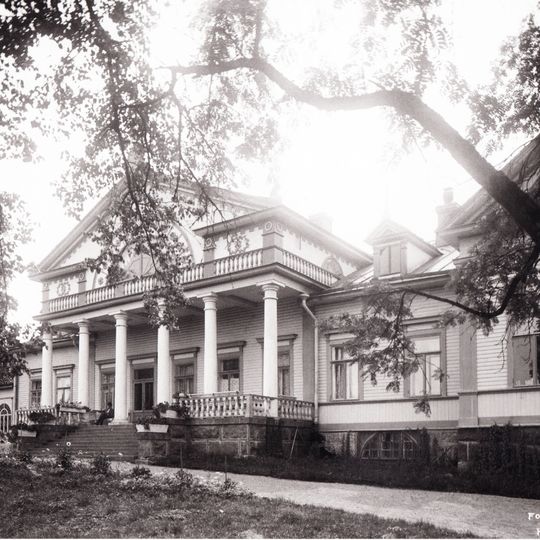
Kiiskilä Manor, Manor house in Podberezye, Russia.
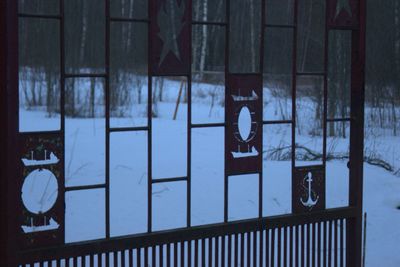
Kiiskilä Manor stands in Podberezye on the western shore of Vyborg Bay, about ten kilometres southwest of Vyborg. Its wooden main building, completed in 1820 to designs by the French architect Villiers, is Palladian in style: a light-coloured symmetrical facade with a triangular pediment, a balustraded balcony and a portico of white columns above the entrance steps, with a lower single-storey wing to one side. A dark reddish-brown metal fence with painted motifs of boats, a life-ring and an anchor stands nearby.
The estate was founded in the 1560s and changed hands several times until Friedrich Dannenberg purchased it in 1818 and built new structures. Later it served as a pioneer camp called Chaika during the Soviet period, owned by a Leningrad shipyard.
The manor's name comes from the Kiiskijoki river, which runs through its lands. Aino Kallas and Helmi Krohn, granddaughters of Julie and Leopold Wilhelm Krohn, wrote about their childhood at Kiiskilä in their books. A sofa set from the manor now stands in the St. Petersburg room of Tampere City Hall.
The manor lies within Russia's border zone, where movement requires a special permit, so access must be arranged in advance. Restoration begun by owner Ilya Sleptsov in 2016 is planned for completion by 2030, with the ground floor intended as a museum.
During the Soviet era, the property functioned as a pioneer camp operated by a Leningrad shipyard. This unexpected use as a seasonal retreat connects the site to the region's industrial past.
The community of curious travelers
AroundUs brings together thousands of curated places, local tips, and hidden gems, enriched daily by 94,307 contributors worldwide.