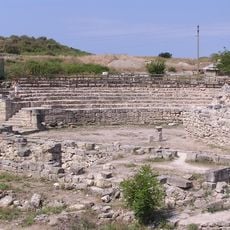
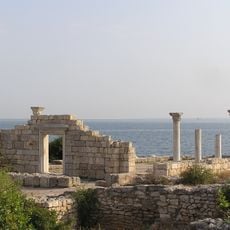
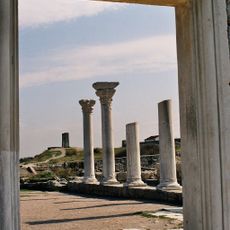
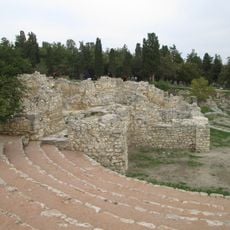
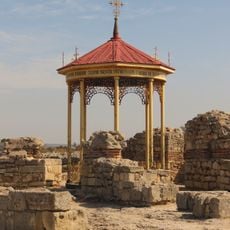
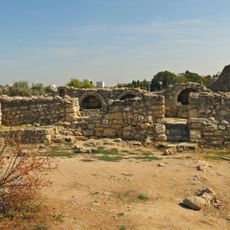
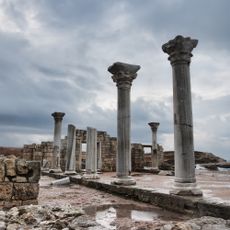
Mint in Chersones, Ancient mint building in Chersonesus Taurica, Sevastopol.
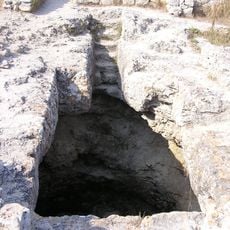
The Mint in Chersones is a structure of large ashlar blocks laid without mortar, so tightly fitted that a knife blade cannot be inserted between them. Four basement rooms survive, linked by a long corridor from which two stone staircases led up, one to the courtyard and one to a ground-floor room. The building burned and a large dwelling was later built on the site.
The structure dates to the 4th–3rd centuries BCE and was excavated in 1904, when 43 blanks for striking bronze coins were found in one of its basement rooms. Coinage at Chersonesos had begun in 390–380 BCE with a first series of silver and copper coins. Around 300–280 BCE the mint struck tetradrachms of about 13.7 g and didrachms of about 6.6 g on the Chian standard.
Coins made here displayed local gods and city symbols, showing how this community controlled its own wealth and trade. These pieces of metal were statements of independence and pride for the ancient people living in this place.
Four basement rooms linked by a long corridor are open to visitors; two stone staircases once led up from it, one to the courtyard and one to a ground-floor room. Much of the basement was excavated and refilled in the 19th century, so only a small share of the underground complex can be seen.
The building's identification as a mint is provisional: it rests on 43 bronze coin blanks found in one basement room. The walls are made of huge ashlar blocks joined without mortar, so tightly that a knife blade cannot be forced between them. After a fire destroyed the structure, a large residential estate was built on the site.
The community of curious travelers
AroundUs brings together thousands of curated places, local tips, and hidden gems, enriched daily by 94,426 contributors worldwide.